WingRight
Texas
Scientific Huffington Post (!) Poll: Ban Abortion After 20 Weeks

20 week ultrasound
#Stand4Life across the US: 59% support a Federal ban on abortion after 20 weeks, even though the question didn’t include an exception for the life of the mother!
Remember that University of Texas/Texas Tribune Poll that showed that 63% or 62% (depending on whether the question mentioned pain or not) of registered voters in Texas wanted a ban on abortion after 20 weeks? Well, it seems that most US voters agree.This poll found that 59% of voters would support a ban, while only 30% oppose it.
The Huffington Post, not a conservative website at all, solicited a scientific poll by the same group that did the UT/TT poll, YouGov. These results agree with last month’s Gallup poll revealing that 64% of Americans believe that abortion should be illegal in the second 3 months of pregnancy and 80% would make it illegal in the last 3 months.
The HuffPost isn’t making a big deal out of the poll, focusing on the conflicting views of the public rather than on the results of the poll itself. In fact, from my GoogleNews search, it doesn’t appear that (as of 7 AM today) anyone other than a couple of blogs (at the Washington Post and the Weekly Standard), National Right to Life, and LifeNews.com are reporting the poll!
Pro-abort McClendon Amendment Redefines “Child”

. . .as someone whose mother chose not to abort him!
Democrat Ruth McClendon, from District 120 of San Antonio, proposed an Amendment to HB 2 today that she thinks is necessary, “if we’re not going to allow women to control their own bodies.” The Amendment would re-define “child” as one,
B. whose mother declares in writing in accordance with rules adopted by the executive commissioner of the Health and Human Services Commission, that, because of Section 245.010 (a), Health and Safety Code, or Subchapters C and D, Chapter 171, Health and Safety Code, the mother chose not to or did not have access to a facility to exercise her right to an abortion at the time the child was born.
Isn’t it obvious that the mother of each and every born child chose not to abort them? Whether or not there’s a “constitutional right?”
And, please, “at the time the child was born?” Does that mean the mother chose not to abort at birth or that she made the declaration at the time of birth?
Representative Kenneth Sheets, Republican from the Dallas-area District 107, explained that his family is going through adoption and that he knows that the same benefits are available to his family and to everyone.
Planned Parenthood, big abortion and the battle to save lives in Texas | Fox News
[R]emind me again why pro-abortion activists want healthy five-month pregnant women to abort their healthy child in dirty, unsafe abortion clinics?
via Planned Parenthood, big abortion and the battle to save lives in Texas | Fox News.
Dr. Love on HB2 #Stand4Life
For a great testimony from a pro-life doctor, look at the House State Affairs Committee video from July 2, 2013 from 3:20 to 3:54 /8:38.
Watch Representative Sylvester (District 139) Turner question Dr. Mikeal Love (that first name is Greek) about whether or not abortionists have hospital privileges. Contrary to the statement by the Counsel of the Texas Hospital Association, Dr. Love reports that 2/3 of Texas abortionists have hospital privileges. Mr. Turner has a real problem understanding the emphatic confirmation that there are doctors whose primary practices are abortion and yet, do indeed have privileges at hospitals.
Representative Helen Giddings, District 109, also tried to trip up Dr. Love, but she only gave him more time to #Stand4Life. She becomes confused and asks whether all Obstetricians/Gynecologists are abortionists, since they all do D&C’s. (The D&C is the method of abortion, but not all D&C’s are abortions.)
Ridiculously, Sylvester Turner ends the questioning of Dr. Love by repeatedly asking whether Dr. Love was paid to give his testimony. Dr. Love answers, “No,” and then is asked again. Wonder if this is a case of a liberal accusing conservatives of doing what liberals are doing?
(I only wish I could speak as well as Dr. Love! I definitely enjoyed watching him debate for life!)
(Edit 7/4/13 11 AM for grammar — BBN link added, too)
Action Alert! Correct False Testimony by the Texas Hospital Association Representative
This is a rare Action Alert: Contact the Texas Hospital Association (phone number, 512-465-1000) about the completely false testimony of their representative, Ms. Stacy Wilson who testified against Section 2 of House Bill 2 before the House State Affairs Committee on Tuesday, July 2, 2013.
You can see Ms. Wilson’s testimony on the July 2, 2013 video of the House State Affairs Committee, available at the House video site beginning at 2:02/8:38.
Ms. Wilson testified as the Associate Counsel for the Texas Hospital Association, against Section 2 of HB 2. That section requires the physicians who perform elective abortions to have admitting privileges at a hospital within 30 miles of the place where he or she does the abortions. Section 4 of the Bill, against which Ms. Wilson did not testify, requires abortion facilities to meet the same standards as State-regulated Ambulatory Surgical Centers.
Ms. Wilson falsely argued that hospitals would not grant admitting privileges to doctors who perform elective abortions outside the hospital because the hospital wouldn’t allow elective hospitals within the hospital: “If you have a physician that is only practicing in a clinic . . . the hospital is unlikely to give privileges.”
Ms. Wilson is apparently unaware that the reason a doctor would have admitting privileges would be to treat complications of the abortion, including hemorrhage, uterine and bowel perforations, and infections after the abortion. There is no reason to claim that the purpose of those privileges would be to allow performing the abortion itself within the hospital walls.
Ms. Wilson repeatedly said that she doesn’t know whether any Texas doctors who perform elective abortions have admitting privileges in Texas hospitals: “It is possible, I mean, say, it’s unlikely, but it’s possible,” and, ““I don’t know of any.”
She also repeatedly stated that it would be wrong for the hospital to be required to grant privileges, while the Bill carries no such requirement: “My testimony is that requiring a hospital to grant privileges for procedures that occur outside the hospital, is an inappropriate.”
Sylvester Turner pounced on Ms. Wilson’s testimony, claiming that Section 2 would outlaw abortion in the State of Texas, since no doctor would be able to get hospital privileges: “We can’t get past this . . . This witness’ testimony is very critical.”
Ms. Wilson doesn’t see any benefit in the usual standard of continuity of medical care: “It seems to me that if a woman has complications, she’s going to come to the Emergency Department, whether her doctor has admitting privileges is irrelevant.” And, “I said that what the woman should do is come to the emergency room where the emergency personnel would render aid.”
Please call the Texas Hospital Association and demand that they correct the misrepresentations of Ms. Wilson.
Update: When you call, you can just ask to leave a message for the Legislative Affairs staff or ask to speak to that office.
Rush Limbaugh explains it all #SB5, #SCOTUS
Rush was talking about the Supreme Court ruling on gay “marriage,” but he might as well have been talking about the Texas Dems, Cecile Richards, and last night’s Mob at the Texas Capitol:
I have often said that what animates people on the left — what motivates them, what informs them — is defeating us. No matter how, no matter what, no matter what it means. Their hatred for us overwhelms anything else. No matter the result, victory that includes impugning and demeaning and insulting us is what they seek. It’s what makes them happy. Now, the left politicizes everything, and in this case, hardball politics became the name of the game.
Chaos, Mob, not filibuster, subverted Texas Senate #SB5 #TxLege
In the Texas Senate, the filibuster is a method of allowing a minority viewpoint known. The minority Legislator is allowed to speak without time limits and without unwanted interruptions, as long as he or she follows the rules laid out beforehand.
Yes, Senator Windy Wendy Davis began a filibuster. She knew the rules, and she broke them. Her fellow Democrat Senators engaged in stalling tactics, but it was the noise and chaos in the gallery that made the three minutes of difference that killed the Bill.
You can watch the Senate video at this page.The
Senators West, Whitmire,Watson, Ellis, Van de Putte, Zaffirini, and (of course) Senator Davis proved to all of us that they value the elective abortion of human beings above orderly government and Legislators.
I was, unfortunately, not shocked that Senator Leticia Van de Putte encouraged the gallery to disrupt the Senate. It also appears that she lied about the timing of her motion to adjourn. See the roll call vote beginning about 12:19/15:50. Note that she spoke and that the temporary President, Senator Duncan, responded after the roll call began. 12:31
I was surprised that the gallery wasn’t cleared much earlier, even though it might have meant that I would have had to leave. However, until the last hour, the outbreaks were intermittent and quickly calmed down.
My friends and I were very concerned about the reaction of those who so clearly showed no respect for the rest of us and who greatly outnumbered the State Troopers. Every seat was full, the pro-life crowd was greatly outnumbered and the halls were crammed with more people in orange. When the standing and shouting became constant, the Lt Governor signaled to the Troopers who began to remove people in an orderly manner.
More Troopers arrived, but they were constantly at risk of physical confrontation, with some of the Orange shirts resisting the request for them to file out. At one point, the Troopers were forced to lock the West doors of the Gallery and the Mob continued to push from the hall and fill the Rotunda.
I certainly didn’t want to be in the middle of a fight with these people and am grateful that the Troopers kept some semblance of order. I don’t believe that there was a way to clear the gallery earlier or with less disruption than we had and am proud of the State Troopers.
Stand for Life Sunday 6/23/13 1PM @ Texas Capitol #SB5 #HB60
#TxProlife and all Texas voters who would stop (or at least limit) the abortions of our little brothers and sisters are asked to join us in a prayerful, peaceful stand in favor of no abortions after 20 weeks, higher standards for abortion facilities and a requirement that the doctors who perform abortions maintain hospital privileges within 30 miles of the facility.
(seriously: doctors should have local hospital privileges, don’t you think?)
Please consider joining us at the Capitol when the House debates these Bills on Sunday. Wear blue, so we can show our numbers.
If you can’t attend, please pray for us and call your Representative’s office to ask for a “yes” vote on SB5 and HB60. Our best chance is to pass the Senate Bill, so the law will go through faster and with less chance of stalling. If the Senate has to agree with a different Bill, there may not be time.
Pray for a peaceful stand for life and courageous Legislators who will defend the Texans of tomorrow!
I won’t be able to follow this page very well during the meeting at the House, but should be able to keep up with those of you who contact me on Twitter, at bnuckols.
Texas State House Affairs Committee Video
The video is online at this page.
RX: Sack cloth and ashes for #SB303 opponents
Searching the news for stories on #SB303, led me to accusations that supporters of the Bill gossiped with Capitol staff and “maligned Texas Right to Life, stooping so low as to criticize our sartorial manners, footwear selections . . . “
When you stop laughing enough to read further, notice that the premise of the article, after turning private gossip into public gossip, is that elaborate conspiracies hidden within the minds of doctors, nurses, and entire staffs of “hospitals” and “facilities” judge the “futility of the patient’s life.”
“We agree that some treatments do stop achieving the intended goal of that specific treatment, such as dialysis no longer filtering uric acid from the blood. When a treatment or therapy is in fact medically futile, no physician would ever continue that, and a properly informed patient or his surrogate would not want to continue futile or harmful treatment, and nothing in current law or in any of Texas Right to Life’s past or present proposals would require the continuation of such medically futile treatment. Physicians would not continue medically futile treatment anyway.”
“Conflicts arise when the futility judgments are transferred from the efficacy of a medical treatment to a value judgment on the futility of the patient’s life.”
Isn’t the entire conversation about whether the doctor determines the “efficacy of a medical treatment?” No,thanks to articles like this one, the debate on medical conscience is all about pretending to read minds and gossip about the motives of doctors, hospitals, bald-faced claims that the Texas Conference of Catholic Bishops is only interested in the “$$$” from Catholic hospital systems. Every discussion I’ve attempted with the opponents of reform devolves into accusations that I “want to kill” patients.
In the grim tale told by TRTL,the physician’s conscience and medical judgment isn’t denied or even trivialized as equal to a lobbyist’s choice of suits or shoes. We, the doctors who are currently the only ones licensed by the State of Texas to write orders and administer treatments, are either ignored altogether or treated as a tool for some mythological eugenic “hospital committees that have decided by their own subjective standards that the lives of these patients have little or no value and should therefore be denied medical treatment.” They object that the physician’s finding that, in his or her “reasonable medical judgment, resuscitation would be medically ineffective” is not defined in the law and accuse us of deciding “that imminent death is better than resuscitative efforts.”
Frankly, I have no idea what that last means, since resuscitation is only needed in the event of imminent or actual natural death, when the heart or breathing stop functioning. Based on this statement and the note about failure of dialysis, I’m certain that no doctors were consulted by or gave feedback to the authors. Again, the lack of physicians who oppose SB 303 is not an indication that we are all involved in a conspiracy. Instead, it is proof of our medical judgment – and consciences.
The end sought by the opponents of SB303 is “treatment-pending-transfer,” including “resuscitative efforts” prescribed by law, not doctors, on every patient who has not specifically refused in advance. When the doctor’s medical judgement and conscience lead him to determine that such would be medically futile, they demand that the doctor set aside conscience and medical judgment and do exactly what they say no doctor would do.
Complete autonomy on the part of patients and their families awarded by legislation the ability to demand what they want, when they want, as long as they want and with as much legal liability as possible cannot turn around the failure of organ system after organ system, and physiological cascade after cascade. All of which we doctors can measure and predict with good certainty.
The authors of this article are proud of their “successful” campaign to ensure for at least two more years, that patients and their surrogates
- don’t have the right to be notified of DNR’s placed on their charts,
- have no protection against the removal of artificial nutrition and hydration,
- don’t have the right to medical records before the medical ethics committee meets,
- don’t have the right to be accompanied in the medical committee meeting, and
- don’t have an additional 7 days to prepare for the medical ethics committee and an additional 14 days to find another doctor willing to accept responsibility for the medical treatment of the patient.
If there is any clothing I’d suggest that the authors wear, it’s the sackcloth and ashes of the repentant sinner.
Texas Judge: Lesbian Couple Can’t Cohabitate –
Some people still try to convince us that it’s a good thing that children have people other than their parents living in the home, in spite of the evidence.
This woman wants out of the contract she agreed to when she got the divorce that was the end of another contract: her marriage. Can’t help but wonder whether a case like this will this be the end of true marriage in Texas. And the end of the rule of law and honoring contracts.
They also said in the statement that the clause “is a burden on parents, regardless of their sexual orientation, that takes away and unreasonably limits their ability to make parental decisions of whom their children may be around and unreasonably limits what the United State Supreme Court has identified as the liberty of thought, belief and expression.”
via Texas Judge: Lesbian Couple Can’t Cohabitate – ABC News.
For a mega-study using data from the CDC, see this article, Blackwell DL. “Family structure and children’s health in the United States: Findings from the National Health Interview Survey, 2001–2007.” National Center for Health Statistics. Vital Health Stat 10(246). 2010.
Denouement: The Death of #SB303
The 83rd Legislature of the State of Texas still has a couple of weeks to go, and it ain’t over ’till both the House and Senate are sine die, but it appears that SB 303 did die over the weekend.
Representative Susan King, who broke her leg last Sunday, just the day before the marathon meeting of the House Public Health Committee, has done an incredible job of working with Senator (Dr.) Bob Duell in their attempt to reform our State’s Advance Directive Act through SB 303.
The Committee Substitute which Representative King presented in the Committee had all of the benefits I wrote about last week, as well as a revision to prohibit a doctor from writing a DNR order against the wishes off a competent patient.
(Talk about unintended consequences: current law is silent on “DNRs,” so it’s apparently legal for a doctor to order that resuscitation not be performed on a competent patient without any discussion with the patient, much less obtain consent! I have sincere doubts that any doctor would do so, but there have been allegations. Even though the ones who claim to have knowledge – and who have not produced one iota of proof – are the same disingenuous cynical scaremongers (I’ll call them “CS2”) I’ve mentioned before, this reform would be a good. And should be accepted on its face.)
Because of the egregious misrepresentations of the CS2, Committee Chair Lois Kolkhorst declined to allow SB303 out of the Committee as it was written. Rep. King tried one more time, with a bare bones CS1 containing the protection against DNRs for competent patients and the prohibition against withdrawal of Artificial Hydration and Nutrition, except when it would harm the patient or hasten his death.
So, for the next two years, when you hear the CS2 complain about Texas “death panels” or read a plea for funds to fight “secret DNRs” and withdrawal of food and water in Texas hospitals, remember the CS2 who killed pro-life reform in the 83rd Legislature.
My Testimony on #SB303 (Conscience, Rights, Medical Judgment and Law)
Note: I’ve heard that there’s a new Committee Substitute that will soon be introduced that is more explicit on DNR’s, especially on informed consent and on competent patients.
If laws demand that physicians perform acts against our consciences, you will end up with only doctors without consciences willing to perform the acts in question.
After a few more words about the meeting of the 83rd Texas Legislature Public Health Committee, I’ll post my written testimony that I turned in to the Committee. You can watch the video of the meeting, here. My testimony begins about 4:59/8:20.
I spoke just before midnight, after many others had covered the good (or bad, depending on their opinions) reforms in SB 303, so I didn’t really go in to those when I talked. Instead, I explained how I handled the few times I’ve had to write DNR’s without consent from the patient or a surrogate.
I also talked about the medical judgement of physicians, about the definition of the “right to life”as a negative right. This means that I can be prohibited from killing, but not that I can be forced to indefinitely act against my conscience and medical judgment. It’s a tough concept, meaning no one can claim that their right to life means that they can take my food and shelter, my labors or my liberty to keep them alive.
Then, I explained that yes, doctors have a special relationship, a covenant or, at least, a professional relationship due to our privilege of practicing medicine. But the duties aren’t unlimited and they are not all one way. The 10 days plus 21 days in the version of SB303 that we were discussing that night should be a sufficient time trial or test of time for the patient and the doctor’s decisions about the medical treatment, including DNR’s, that the family demands.
The explanation about the nature of medical judgment that I gave is in the written testimony:
May 13, 2013
Chair Kolkhorst and members,
The Texas Advance Directive Act of 1999, created a procedure for resolving disagreements between doctors and their patients or surrogates about which interventions are medically appropriate. The experiences of patients and doctors during the few times that procedure has been invoked over the years, revealed some problems.
The reforms in SB 303 improve the Advance Directive Act by
· Giving patients and their surrogates much more time and assistance than current law provides in order to prepare for the ethics committee meeting and, if necessary, to find a new doctor willing to accept responsibility for the care of the patient,
· Clarifying the succession of surrogates under state law,
· Protecting the patient’s access to artificially administered hydration and nutrition,
· Restating Texan’s belief that patients should be treated equally regardless of age, disability or ability to pay,
· Adding a whole new section regulating the implementation of Do Not Attempt Resuscitation orders, which our State law hasn’t addressed at all in the past, and
· By protecting the conscience rights of doctors from undue threat of civil, criminal and regulatory liability.
After all, while the hospital provides structure in the form of policies and the medical committee provides oversight about ethics and standard of care, it’s doctors like me, not hospitals or committees, who practice medicine using our medical education and experience guided by conscience, or medical judgment. Medical judgment, not lawyers and paperwork at the bedside, is what enables me to predict the effectiveness of interventions before I order them.
Like all but a handful of Texas doctors, I’ve never had to ask for a medical ethics committee review, but I have had to ask another doctor to co-sign a DNR when I couldn’t find a legal surrogate. As a family doctor, I’ve found that algorithms and “cookbook medicine” or lines of succession for absent family members sometimes aren’t enough when a patient’s physical condition is deteriorating quickly or even when disease runs its expected course, causing organ system after organ system to fail.
Ethics and laws generally lag behind medical advances. Once upon a time, people who couldn’t breathe for themselves were considered to have died a “natural death,” but we keep changing the rules about what we expect human bodies and the “art” of medicine to do. Please support the necessary and important reforms in SB 303.
Thank you for your time and attention,
Beverly B. Nuckols, MD, FAAFP, MA (Bioethics)
Public Health Hearing on #SB303
Last night, an emergency meeting ot the 83rd Texas Legislature’s Public Health Committee addressed Senate Bill 303, by Senator Duell in a 12 hour long meeting. Representative Susan King, who authored the Companion Bill in the House and sponsored SB303 in this meeting, appeared only one day after a fracture of her tibia. This woman is a hero!
I also want to thank Chair Lois Kolkhorst for ensuring that the meeting was held so that SB303 – and all the people who are so passionate about patients rights and good medicine in Texas could be heard.
It was wonderful to see all the people who volunteer so much of their time to influence Texas law – even when they disagreed with me. What a pleasure to meet new friends, including a gentleman whose name I can’t recall (will fix this later) and Jacqueline Harvey, Ph.D.
Here’s an excerpt from Dr. Harvey’s testimony,
While opponents say that S.B.303 grants power to providers to remove care patients in irreversible conditions, I’d remind them again that one cannot extend to providers power which they already legally possess. Opponents claim that S.B. 303 adds this broad definition, when in fact; this broad definition was established in TADA and is current Texas Law. What S.B. 303 does is add protections to prohibit discrimination against persons with disabilities by ensuring that care may be removed only when harmful (i.e. treatment would fail, hasten patient death, exacerbate another medical condition or cause unnecessary pain). These conditions are standard medical ethics a la “do no harm.”
I’ll write more after I get a chance to review the video of the hearing. There’s some sort of glitch at the Legislature Audio and Video page. (Might have something to do with 12 hours of recordings, ending after 2 AM)
Going Too Far with DNR? | Texas Catholic Conference
“Father Tad” is the Director of Education at the National Catholic Bioethics Center. The Texas Catholic Conference published his commentary on “DNR’s” on May 10, 2013.
These judgments are tricky to make, because the specifics of each case differ, and those specifics change with time and disease progression. DNR’s should be put in place only when the circumstances warrant it, that is to say, on a case-by-case, patient-specific basis. In other words, when CPR/resuscitation can reasonably be determined to no longer offer a hope of benefit to the patient or if it entails an excessive burden to him, at that time a DNR can be put into place.
Some of the possible burdens that may need to be considered in deciding whether to pursue resuscitative interventions for a patient would include some of the following: the risk of rib or other bone fractures, puncture of the lungs by a broken bone (or from the trauma of lung compression and decompression), bleeding in the center of the chest, cerebral dysfunction or permanent brain damage, the small risk (about 3 or 4 percent) that the patient might end up entering a vegetative state, and subsequent complications if the patient ends up staying on a ventilator for an extended period following the resuscitation.
During resuscitative efforts, elderly patients are more likely to experience complications or to have ribs break during CPR. Younger patients, on the other hand, tend to show a greater resilience and are often better able to tolerate CPR. Patients suffering from advanced cancer are also known to fare poorly following resuscitative efforts.
In terms of overall statistics, when a patient codes in the hospital and all resuscitative measures are taken, patients frequently do not end up leaving the hospital, especially when they are elderly or have other co-accompanying conditions. Based on data from the National Registry of Cardiopulmonary Resuscitation (NRCPR), studies have determined that patients who undergo cardiac arrest in the hospital have an overall survival to discharge rate of about 17 percent. The rate drops even lower (to around 13 percent) for cancer patients. In other words, the benefits are oftentimes few and short-lived, while the burdens tend to be high. There are, of course, exceptions — while many patients do not experience significant benefits from resuscitative measures, a small percentage do.
So when death is imminent, and disease states are very advanced (perhaps with multiple organ failure), and assuming other spiritual matters, such as last sacraments, have been addressed, a DNR order may not raise any moral problems. The key consideration in making the judgment will be to determine whether the benefits of resuscitation outweigh the burdens. So when death is imminent, and disease states are very advanced (perhaps with multiple organ failure), and assuming other spiritual matters, such as last sacraments, have been addressed, a DNR order may not raise any moral problems. The key consideration in making the judgment will be to determine whether the benefits of resuscitation outweigh the burdens.
DNR orders can be misused, of course, if they are broadly construed as calling on medical professionals to abandon or otherwise discontinue all care of a patient. Even as patients may be declining and dying of serious underlying illnesses, we must continue to care for them, support and comfort them, and use the various ordinary means that they may have been relying on, such as heart and blood pressure medications, diuretics, insulin, etc.
We should always seek to do what is ethically “ordinary” or “proportionate” in providing care for our loved ones, though we are never obligated to choose anything that would be heroic, disproportionate or unduly burdensome when it comes to CPR or other resuscitative measures.
More than “a list of endorsements” (with Addendum)
An opponent of SB 303 and I have been discussing the Bill on an earlier post. She referred to my “list of endorsements.” This is a fairly strong list of endorsements, at least for those of us who are believers, don’t you think?
The Texas Baptist Christian Life Commission is ” is pleased that SB 303 was recently voted out of the senate.”
Texas Catholic Bishops letter to members of the Texas House of Representatives urging support for SB 303
The Morality and Wisdom of Incremental Legislation: The Case for SB 303 by Rev. Tadeusz Pacholczyk, Ph.D.
Point by Point Refutations of Criticisms to SB 303
Texas Catholic Conference Handout comparing SB 303 with current law
Texas Catholic Conference’s response to NRLC’s analysis of SB 303
National Catholic Bioethics Center letter supporting SB 303
National Catholic Partnership on Disability letter supporting SB 303
Texas Catholic Conference Policy Backgrounder on Advance Directives Reform
Texas Catholics Bishops Conference been very active over in the many efforts over the years to reform of the Texas Advance Directive Act and all have signed the endorsement strongly urging passage of SB303 http://www.txcatholic.org/press-releases/336-texas-catholic-bishops-strongly-urge-house-vote-on-end-of-life-care.
I’ve relied on the National Catholic Bioethics Center ( Marie Hilliard and Father Tad) for their consistent and coherent efforts to preserve traditional medical ethics. NCBC has also endorsed the Bill, and written an excellent response to criticism of SB303.
Added 5/11/13 at 11:00 AM, more endorsements and information:
- Senate Bill 303
- House Bill 1444
- John M. Haas, Ph.D., President, National Catholic Bioethics Center, letter supporting SB 303
- Texas Catholic Bishops letter to members of the Texas House of Representatives urging support for SB 303
End-of-Life Ethics: Preparing Now for the Hour of Death – Catholic Update August©2006
Here is another discussion about the end of life for my Catholic friends who are trying to decide whether to support SB 303.
Life, however, is not an absolute good.
Treatment and life support
Questions about the use of medical treatments and life-support systems are distinct from—and yet often associated with—euthanasia. The scriptural insights can be very helpful with these issues, even if they cannot give details. As good stewards, we believe that death is not the final word, that life is not an absolute good. Therefore, we do not have to keep someone alive “at all costs.”
The Catholic tradition helps with the details, providing this guidance: ordinary means must be used; extraordinary means are optional. Ordinary means are medicines or treatments that offer reasonable hope of benefit and can be used without excessive expense, pain or other inconvenience. Extraordinary means do not offer reasonable hope of benefit or include excessive expense, pain, or other inconvenience. What is important to remember is that “ordinary” and “extraordinary” refer not to the technology but to the treatment in relation to the condition of the patient, that is, to the proportion of benefit and burden the treatment provides the patient (see the Vatican’s Declaration on Euthanasia, #IV, 1980).
Many people remember when Cardinal Joseph Bernardin of Chicago decided to stop the treatment for his cancer. The treatment had become extraordinary. He did not kill himself by this choice but did stop efforts that prolonged his dying. He allowed death to occur. (This distinction between allowing to die and killing, as in euthanasia or assisted suicide, is of great significance in the Catholic tradition. The rejection of this distinction by several U.S. courts raises serious concerns.)
Within the Catholic Church, debate still surrounds the question of providing medical nourishment through a feeding tube. Let’s look at two positions.
1) “Life must almost always be sustained.” This position holds that the withdrawal of medically assisted nutrition and hydration cannot be ethically justified except in very rare situations. The fundamental idea for this position is the following: Remaining alive is never rightly regarded as a burden because human bodily life is inherently good, not merely instrumental to other goods. Therefore, it is rarely morally right not to provide adequate food and fluids.
This position acknowledges that means of preserving life may be withheld or withdrawn if the means employed is judged either useless or excessively burdensome. The “useless or excessive burden” criteria can be applied to the person who is imminently dying but not to those who are permanently unconscious or to those who require medically assisted nutrition and hydration as a result of something like Lou Gehrig’s or Alzheimer’s disease. Providing these patients with medical nourishment by means of tubes is not useless because it does bring these patients a great benefit: namely, the preservation of their lives.
2) “Life is a fundamental but not absolute good.” This approach rejects euthanasia, judging deliberate killing a violation of human dignity. On the other hand, while it values life as a great and fundamental good, life is not seen as an absolute (as we saw in the section on scriptural foundations) to be sustained in every situation. Accordingly, in some situations, medically assisted nutrition and hydration may be removed.
This position states that the focus on imminent death may be misplaced. Instead we should ask if a disease or condition that will lead to death (a fatal pathology) is present. For example, a patient in a persistent vegetative state cannot eat enough to live and thus will die of that pathology in a short time unless life-prolonging devices are used. Withholding medically assisted hydration and nutrition from a patient in such a state does not cause a new fatal disease or condition. It simply allows an already existing fatal pathology to take its natural course.
Here, then, is a fundamental idea of this position: If a fatal condition is present, the ethical question we must ask is whether there is a moral obligation to seek to remove or bypass the fatal pathology. But how do we decide either to treat a fatal pathology or to let it take its natural course? Life is a great and fundamental good, a necessary condition for pursuing life’s purposes: happiness, fulfillment, love of God and neighbor.
But does the obligation to prolong life ever cease? Yes, says this view, if prolonging life does not help the person strive for the purposes of life. Pursuing life’s purposes implies some ability to function at the level of reasoning, relating and communicating. If efforts to restore this cognitive-affective function can be judged useless or would result in profound frustration (that is, a severe burden) in pursuing the purposes of life, then the ethical obligation to prolong life is no longer present.
Disagreements in the Church
How are these significantly different positions judged by the Roman Catholic Church? There is no definitive Catholic position regarding these two approaches. Vatican commissions and Catholic bishops’ conferences have come down on both sides of the issue. Likewise, there are Catholic moral theologians on both sides.
via End-of-Life Ethics: Preparing Now for the Hour of Death – Catholic Update August©2006.
Emphasis by underlining is mine. Edited 5/10/13 BBN
Opponents of SB303 Promote Doctors Without Conscience
The opponents of Senate Bill 303 may not realize it, but they are promoting the very thing they claim to oppose: elevating the patient’s right to determine his own care above the doctor’s conscience will result in doctors who practice medicine without consciences.
The consequences of elevating autonomy above non-maleficence (“first do not harm”) go to the very heart of medical ethics. In fact, the promotion of patient autonomy is the common justification for euthanasia and elective abortion on demand.
The doctor is the one whose hands, conscience, and medical judgment will be writing the orders for or actually carrying out the resuscitation. Just as it’s not ethical to force doctors to cause the death of patients, it’s not ethical to demand that doctors write orders and perform interventions when their medical judgment indicates that the intervention will not be successful and will increase pain and suffering while prolonging the process of death.
As ethicist Gilbert Meilaendar noted at the President’s Bioethics Council Meeting in September 12, 2008,
[T]he reason for a physician being willing to risk his life in an epidemic was precisely that he didn’t think staying alive was the most important thing, that there was something else that was morally more compelling and obligatory even than preserving his existence. And that would have something to do with the personal integrity that you seem willing to think may be — one should be willing to set aside in embracing what one thinks is evil.
Dying, Naturally, in the Emergency Department
Here’s an excellent professional article about end of life care for patients that’s relevant to our discussion about SB 303.
Two Roads to Death
Two major pathways to death have been described: The easy and the difficult road Figure 1. Depending on the road a patient takes, the intensity of ED management may vary significantly. For instance, some patients are highly symptomatic at the EOL, requiring intravenous medications and even continuous drips to maintain comfort while others can be managed by relatively simple oral regimens in the home setting, with the support of hospice services.For symptoms like pain, the EM skill set proves sufficient as the management of healthy patients and those at the EOL is similar. EM treatment algorithms are less relevant, however, for symptoms like dehydration, delirium and dyspnea in the dying patient. For this reason, we will focus our attention on the unique approach to these common and often troublesome EOL issues.
Man shot and killed at Houston’s Bush Intercontinental Airport – CNN.com
This looks like the man chose to commit suicide, but the story might change.
(CNN) — A man was shot and killed Thursday in a pre-screening area at Bush Intercontinental Airport in Houston, authorities said.Houston Police Department spokesman Kese Smith told reporters that the man had just come through the doors in Terminal B when he fired at least one shot into the ceiling.
A Homeland Security Investigations agent was working in an office near the scene, came out and told the man to drop his weapon. The agent fired once at the suspect, who appeared to try to shoot himself at the same time.
An autopsy will determine whose bullet killed the man, who has not been identified, police said.
via Man shot and killed at Houston’s Bush Intercontinental Airport – CNN.com.
Update on the Texas Advance Directive Act (SB 303)
The Texas Advance Directive Act of 1999 (TADA) describes “Advance Directives to Physicians” (what most people would call a “Living Will”) and contains Section 166.046, an attempt to outline the procedure for resolving a disagreement between a doctor and patients or their surrogates about what is medically appropriate treatment.
The law currently in effect requires the doctor to notify the patient or the surrogate when he or she believes that their request is medically appropriate. If there is still a disagreement, the doctor asks the hospital to convene a meeting of their ethics committee. If the committee agree agrees with the doctor, and no other doctor is willing to take over the care of the patient, the treatment in question can be withheld or withdrawn. TADA doesn’t allow “Physician Assisted Suicide” and certainly doesn’t allow euthanasia, where the patient might be killed on purpose.
The Texas Senate passed Senator Bob Duell’s Senate Bill 303, which significantly improves current law. SB 303
- Requires the doctor to notify the patient or his surrogate before writing a “Do Not Attempt Resuscitation” order,
- Prohibits the withdrawal of artificially administered hydration and nutrition except in extreme circumstances and
- Gives families 5 days instead of 2 to prepare for the ethics committee meeting and 21 days instead of 10 before the patient must transfer care to another doctor,
- Outlines the duties of the hospital to treat all patients the same, regardless of age, disability, or ability to pay, to provide a trained liaison to assist the family, and requires timely copies of the medical records.
Because SB 303 still needs to pass in the House, Texas Alliance for Life asked me to help them make a video explaining how it reforms current law.
If you agree that SB 303 is a pro-life reform Bill please call your State Representative at 512-463-4630 and ask him or her to support SB 303.
My “Ethics 101” on the law: “Back to Basics on Texas Advance Directive Act”
Thank your Texas Senators for a Good Bill!
Texas Senate Passes Pro-Life SB 303 to Help FamiliesProtect Loved Ones Near the End of LifeLt. Governor David Dewhurst and Sen. Donna Campbell M.D. Deserve Thanks!April 24, 2013Dear Larry and Beverly:Very good news! Last week the Texas Senate passed SB 303, a strong pro-life bill that will change current law to help families protect their loved ones near the end of life.Supported by pro-life Lt. Governor David Dewhurst and authored by Sen. Bob Deuell (R-Greenville), the full Senate passed SB 303 on a decisive 24-6 vote.
Your Texas state senator, Sen. Donna Campbell M.D., voted to support SB 303, a pro-life vote. Please thank Lt. Governor Dewhurst and Sen. Campbell for their support. See sample messages below.SB 303 is strongly supported by broad coalition of pro-life and provider organizations including Texas Alliance for Life, the Texas Catholic Conference of Bishops, and the Texas Baptist Christian Life Commission.Voting for SB 303 were: Campbell, Carona, Davis, Deuell, Duncan, Ellis, Eltife, Estes, Fraser, Garcia, Hinojosa, Huffman, Lucio, Nelson, Nichols, Rodriguez, Schwertner, Seliger, Uresti, Van de Putte, Watson, West, Whitmire, and Zaffirini.Voting against SB 303 were: Hancock, Hegar, Patrick, Paxton, Taylor, and Williams. Senator Brian Birdwell was absent.(snip)


-
Prevents secret DNAR orders (“Do Not Attempt Resuscitation”). Current law allows doctors to order DNARs without even notifying the patient or family.
-
Prevents the involuntary denial of food and water, except in extreme circumstances when the treatment would harm the patient or hasten his or her death.
-
Increases the time of the dispute resolution process from 12 to 28 days when a family and patient disagree about appropriate end of life care.
-
Significantly limits the class of patients to whom the dispute resolution process can be applied.
-
Requires doctors and hospitals to treat all patients “equally without regard to permanent physical or mental disabilities, age, gender, religion, ethnic background, or financial or insurance status.”
-
Preserves conscience protections so physicians are not required to provide futile or harmful procedures indefinitely.
A great deal of false and misleading information about SB 303 has been spread by several groups, especially by one group in particular that is based in Houston. In response, the Texas Catholic Conference of Bishops issued a strongly-worded letter to set the record straight. Please see this: http://txcatholic.org/news/327-misstatements-against-end-of-life-care-reform-corrected-in-letter-to-lawmakers
See my earlier post about the rebuke TRTL received from the Texas Catholic Bishops Conference. – http://wp.me/p1FiCk-XW – and an even earlier explanation (long winded, I’m afraid) – http://wp.me/p1FiCk-Wb
Edited 4/27/13 to add that last paragraph – BBN
Border Patrol now counts getaways – Beaumont Enterprise
Note the estimated 85,000 who escaped the Border Patrol in 2011. Secure the border, first, then we can talk about how to get a Green Card. (Hint: it begins by getting in line legally and in their own country.)
A recent Government Accountability Office report cites Border Patrol data from fiscal 2011, the latest available, that 61 percent of estimated illegal crossings on the southern border resulted in capture, 23 percent turn back to Mexico and 16 percent got away.Of the 85,467 who got away, 70,980 (83 percent) were counted by sign-cutting, with nearly all the rest from cameras and plain sightings.
Despite such precise tallies, Border Patrol Chief Mike
via Under pressure, Border Patrol now counts getaways – Beaumont Enterprise.


Obama Gives $13 Million Grant to Texas Planned Parenthood! @txprolife
We’ve all been hearing about the supposed “War on Women” by Conservative law makers – and, by extension, voters – in Texas. Well, President Obama and Secretary of Health Kathleen Sebellius just fired another shot in the war against Texas and State’s rights.
UPDATE: In an emailed statement, Texas Department of State Health Services spokeswoman Carrie Williams says that the agency just received notice that it will lose the Title X grant and is “reviewing the information to get a sense of the full impact.” The agency hopes the transition is smooth and the provider base remains strong, she wrote.
EARLIER: The federal government has pulled from the state of Texas millions in family planning funding, granting the money instead to a coalition led by the Women’s Health and Family Planning Association of Texas, which says it can serve a greater number of women with the available funds.
For more than four decades, federal Title X funding has been dedicated to funding family planning services and covering clinics’ infrastructure costs. The funds are generally granted to providers (like Planned Parenthood) and/or to state health agencies. In Texas since 1980, the majority of the funding has been administered by the Department of State Health Services — roughly $18 million in 2012, for example; since 2009, DSHS has been the sole grantor of Title X funds.(Edit, maybe it’s only half of that.)
A Little History
Before this year, Federal tax dollars came back to Texas in two major funds: the Women’s Health Program and Family Planning, or Title X funds. Texas “matched” a certain amount and the Texas Department of Health and Human Services administered the dispersion of the money. Because the money paid for or freed up other funds for staff, marketing, and “infrastructure” or office overhead, PP was helped to keep their abortion clinics running. The overall effect was that State matching tax dollars helped PP to funnel patients, if not dollars, to their abortion clinics.
Texas was forced to make severe Budget cuts across the board in 2011, including Family Planning funds. This led to prioritizing what little money we had:
“State lawmakers cut funding for family planning services by two-thirds in the last legislative session, dropping the two-year family planning budget from $111 million to $37.9 million for the 2012-13 biennium. They also approved a tiered budget system for family planning funds, which gives funding priority to public health clinics, such as federally qualified health centers and comprehensive clinics that provide primary and preventative care over clinics that only provide family planning services.”
Finance Chairman Representative Jeb Henserling of Texas

SPEAKING to National Pawnbrokers Association in Washington, School.
Our Texas Senators Cornyn and Cruz at Capitol
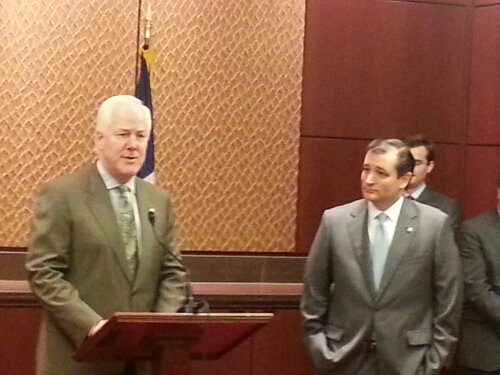
The Senators spoke to a group including Larry Nuckols and I, who were in DC representing the National Pawnbrokers Association.
Texas will pay for destructive human embryo cloning at Texas Universities
The Committee Substitute was passed this afternoon with 9 yes votes in the House State Affairs Committee. The Chairman of the Committee, Byron Cook voted “yes,” after assuring the Committee that the Bill (which is not available online or in the Committee) will not outlaw human cloning at Universities.
Voting “no” were four brave Republicans – I’ll list them all as soon as I can verify and make sure I don’t miss anyone. Unfortunately, some of our conservative members weren’t present. I will also name them when I can do so without missing anyone.
I worked with Representative Raymond’s office to come up with good definitions, but I don’t know how much of those definitions made it into the final Bill.
Luckily, in spite of the lies we’ve read over the years, no one has yet been able to clone a human embryo.
What is now encouraged is the purposeful creation of a human embryo by cloning. The embryo may never be implanted, but the Bill declares that the nascent human should be killed and broken up
Click here to get your “Choose Life” license plate

Rick Perry RickPAC
Yes, I'm still for Governor Perry!
RickPAC
SiteMeter
 WingRight