WingRight
Money and Finance
Rick Perry’s Fix: 20% Flat Tax, Cap Spending at 18% of GDP – ABC News
“The plan starts with giving Americans a choice between a new, flat tax rate of 20 percent or their current income tax rate,” Perry writes. “The new flat tax preserves mortgage interest, charitable and state and local tax exemptions for families earning less than $500,000 annually, and it increases the standard deduction to $12,500 for individuals and dependents.”
The plan also drops the corporate tax rate to 20 percent and will temporarily lower the rate to 5.25 percent to promote companies working overseas to move to the U.S. along with implementing a “territorial tax system,” which will tax in-country income.
The plan will eliminate the death tax and end taxes on Social Security, which would help an estimated 17 million Americans receiving benefits today. It would also cut taxes on qualified dividends and long-term capital gains.
Perry sets a goal to balance the budget by 2020 by capping federal spending at 18 percent of GDP, banning earmarks and future bailouts and passing a balanced budget amendment.
Until the budget is balanced, Perry’s plan would freeze federal civilian hiring and spending, and place a moratorium on all pending federal regulations, along with auditing any regulations, instituted since 2008.
Perry promises the repeal of President Obama’s health care plan, Dodd-Frank and Sarbonnes Oxley.
On entitlement reform, Perry says his plan will stop the “raiding” of the Social Security Trust Fund and allow younger generations to set up personal retirement accounts.
via Rick Perry’s Fix: 20% Flat Tax, Cap Spending at 18% of GDP – ABC News.
Rick Perry: My Tax and Spending Reform Plan – WSJ.com
On Tuesday I will announce my “Cut, Balance and Grow” plan to scrap the current tax code, lower and simplify tax rates, cut spending and balance the federal budget, reform entitlements, and grow jobs and economic opportunity.
The plan starts with giving Americans a choice between a new, flat tax rate of 20% or their current income tax rate. The new flat tax preserves mortgage interest, charitable and state and local tax exemptions for families earning less than $500,000 annually, and it increases the standard deduction to $12,500 for individuals and dependents.
Perry’s Flat Tax vs. Cain’s ?-?-? Tax: Which has less risk?
The Republican candidates for President have all promised to simplify the tax code and make it more fair. Governor Rick Perry’s plan for a Flat tax will be revealed tomorrow (October 25) and it’s already being compared to Herman Cain’s “999” tax plan.
From what I’ve read about Governor Rick Perry’s flat tax plan (see the Wall Street Journal article, here, and Fox News article, here), the bureaucracies would be much simpler – that’s one reason they call it “flat:” a single tax bracket with a standard deduction per person would require very little in the way of new procedures at the IRS. If anything, it would decrease the personnel needed and there would be less need for “interpretation” of the tax code.
We certainly wouldn’t need more tax regulations, IRS employees or arbitrary decision making within the Treasury Department under Perry’s plan. The tax payers would have the option of using the old code or the new, flat bracket with a deduction off the top for each person in the family.
Currently, there’s a provision for a Newspeak-named “alternative minimum tax.” After a certain income level, people have to figure their taxes two ways, with and without certain deductions. They pay the greater amount.
There aren’t separate bureaucracies for those who pay the current regular tax and for those who pay the “alternative minimum tax.” The same crowd audits both.
On the other hand, Herman Cain’s 9-9-9 tax plan has already been tweaked, to make it more “fair.”
Mr. Cain says he has changed the 9% income tax (the middle “9” in that scheme) to the 9-0-9 with 0% income taxes for those that Washington deem “impoverished” and the brand new “empowerment zones” for favored cities and communities. In addition, the sales tax would require larger, newer bureaucracies, since there are currently no rules or regulations for monitoring or collecting a National sales tax, identifying who is paying it or who is not. That bureaucracy would have to be developed, along with reams of regulations made up from whole cloth.
In addition, the biggest flaw in Mr. Cain’s 9-?-9 tax plan in my opinion is that the very areas that are Democrat-controlled and and rife with corruption would be the places that Cain proposes to put “empowerment zones.” These “zones” nor the regulations to define or run them do not exist. How long ’till the corruption sets in? Who gets paid to develop more empowering empowering zones that favor the current powers that be? Who gets paid to look the other way when some are “empowered” more than others?
Edited for grammar – BBN 10/25/11, 4 AM
Medicare meltdown, Obamacare next
Texas Medical Association held our Fall Conference today, and the theme was the “Calendar of DOOM!” I’m afraid they’re right.
(Since the Bastrop fire was only a few miles east of the Austin location, it’s sort of unfortunate that the slogan was “Don’t be burned!” The graphics showed lava flow and volcanoes, but still!)
Even if “Obamacare” is repealed tomorrow, doctors and patients are facing huge changes in the next few months. It’s too late to avoid a lot of these changes, unless Medicare rules are overturned completely.
Docs who didn’t use electronic prescribing have until Nov.1 to file with Medicare for an exemption to avoid losing an extra 1% on Medicare payments next year (it’s too late, trust me).
The Centers for Medicare and Medicaid have hired private contractors, called Recovery Audit Contractors (RACs), to review doctors’ notes and billings. The RACs make more money if they find more mistakes in the doctor’s office. Errors will be counted as fraud, and fines will be placed. Docs’ will pay up or have their payments from Medicare held, even though they appeal.
All of us who see Medicare patients face a 29.5 % cut as of January 1, 2011.We’ve faced cuts under the inappropriately named “Sustainable Growth Rate” for Medicare (where the more patients are seen, the less doctors are paid because the total spent wasn’t supposed to increase) (see this explanation), but they’ve always been deferred. Under the “Super committee” legislation that was created under the law that allowed for that last increase in the National debt level, I wouldn’t be surprised if some of this cut goes though.
Doctors have been very restricted in our ability to invest in labs, hospitals, and medical businesses for years. Next year that will be decreased even more. Bean counters, lawyers, anyone other than a physician may own a hospital.
And then, there’s an HMO/capitated managed care plan that was pushed by President Obama and included in Harry Reid’s midnight move to pass “health reform,” called “Accountable Care Organizations.” (Watch this cartoon.)
The Centers for Medicare and Medicaid published rules yesterday
Remember those examples of ideal hospital systems that President Obama used back when he was selling his healthcare reform? As soon as the law was passed, and we were able to read it, those systems declined.
During the health care debate, the Mayo Clinic, the Cleveland Clinic, Geisinger Health System and Intermountain Healthcare were repeatedly touted as models for a new health care delivery system.
Now, they have something else in common: All four have declined to apply for the “Pioneer” program tailor-made by the Obama administration to reward such organizations.
while keeping costs down. The ACO provision became one of the most highly anticipated elements of the health care overhaul, and providers embarked on a frenzied race to join in as quickly as possible. (via ‘Poster Boys’ Take A Pass On Pioneer ACO Program – Kaiser Health News.)
Stay healthy, y’all!
To The Point News – THE REVOLUTION WILL EAT ITS OWN
This article, from “To the Point News,” a subscription website with conservative commentary, reviews the French Revolution, but it also makes the important point that increasing taxes and regulation on “the rich” will decrease the incentive and the ability of the “the rich” to earn the money to pay those taxes. (A slightly different version of the column is available, here, for free.)
(See addendum at bottom.)
******
Of the 80% of Americans who still have jobs, most have experienced very little decline in living standards. But for those who have lost their job and been unable to find a new one, the shock, both to their pocketbook and psyche, has been severe.********
In poor societies, there are always a few rich people; and in rich societies, there are always a few poor people. A successful society is characterized by fewer poor each year and more middle class and rich. Revolutions take place when the number of poor rises faster than the number of middle class and rich. The poor, being less educated and having more of a static view of the world, blame their increasing hardship and numbers on the rich.
The real villains are those in the political class who pandered to the voter by promising more in benefits to be paid for by others, whom are demonized as “the evil rich.” But if the rich people are taxed too much, they opt out by moving or no longer being rich, and then the tax revenues fail to keep up with the increases in spending until finally, the debt burden slowly sinks the ship.
This is precisely what is going on in the United States and most European countries at the moment.
As more and more people lose their jobs, the demand for government payments grows, making the situation worse and worse. The U.S. government is spending roughly 40 percent more than it is taking in. President Obama and others are demanding higher taxes on the “rich” – more correctly known as job creators – to pay for more government benefits. The self-delusion of the political class goes on, and the numbers get worse.
Notice that the president, when arguing that his “jobs” bill is going to increase jobs, quotes the same economists who also said his “stimulus” would keep unemployment under 8 percent, rather than referring to those economists who were correct in saying it would fail. The president’s assertion that by increasing the taxes on the rich he will be able to “pay” for all his new spending is fantasy, or worse.
The simple fact is that the amount of explicit and implicit debt that the United States and other governments have incurred cannot and will not be paid back in full. The political class will try to cure the debt mess with inflation, price controls, tax increases and confiscation, but it will only make things worse.
Greece is only the first canary to die. As more and more jobs and homes are destroyed by the debt crisis, the ranks of the revolutionaries will grow until, finally, the new “peasants” realize that the rich are gone and it is the political class who is responsible for the mess.
As Mr. Obama and many liberal Democrats embrace the Wall Street protesters, I wonder if they have not only forgotten (or ever knew) good economics, but also the lessons of history. Maximilien Robespierre, a great orator, most certainly did not intend for himself to be guillotined as he and his colleagues unleashed the Reign of Terror during the French Revolution.
As his Committee of Public Safety replaced the Committee of General Defense and his Committee of General Security (sounds all too much like “Homeland Security” organized the secret police, it is most unlikely that he thought the organizations he headed would end up beheading him.
The Reign of Terror was launched with the King of France, Louis XVI, guillotined in the Place de la Revolution (now the Place de la Concorde) in Paris on January 21, 1793, and reached full fury with the Queen of France, Marie Antoinette, guillotined there 9 months later on October 16. The revolutionary slaughter ended with the “National Razor” falling on Robespierre’s own neck on July 28, 1794.
The French were subsequently slow to follow the American democratic model – the ballot box – which is a much cleaner and more civilized way to get rid of failed leaders.
We can look forward to the day when the current political actors, like Jimmy Carter now, merely dance around us with occasional annoying utterances rather than stealing from our pocketbooks and chipping away at our liberties.
Richard W. Rahn is a senior fellow at the Cato Institute and chairman of the Institute for Global Economic Growth.
As evidence in support of the above, here are links to two Wall Street Journal articles, one from 2009 and one from this year:
Maryland couldn’t balance its budget last year, so the state tried to close the shortfall by fleecing the wealthy. Politicians in Annapolis created a millionaire tax bracket, raising the top marginal income-tax rate to 6.25%. And because cities such as Baltimore and Bethesda also impose income taxes, the state-local tax rate can go as high as 9.45%. Governor Martin O’Malley, a dedicated class warrior, declared that these richest 0.3% of filers were “willing and able to pay their fair share.” The Baltimore Sun predicted the rich would “grin and bear it.”
One year later, nobody’s grinning. One-third of the millionaires have disappeared from Maryland tax rolls. In 2008 roughly 3,000 million-dollar income tax returns were filed by the end of April.
And: “Review: Millionaires Go Missing”
Speaking of “millionaires and billionaires” (see here), the real tax news is that there are fewer of both these days. This month the IRS released more detailed tax data for 2009, and the nearby table records the decline of the taxpaying rich.
In 2007, 390,000 tax filers reported adjusted gross income of $1 million or more and paid $309 billion in taxes. In 2009, there were only 237,000 such filers, a decline of 39%. Almost four of 10 millionaires vanished in two years, and the total taxes they paid in 2009 declined to $178 billion, a drop of 42%.
The Kindness Of Capitalism: How The Texas Economy Cares For The Community
Here’s a bit of an essay by Melissa Clouthier.
People have had to make Texas what they want it to be. They have wildly succeeded.
The government reflects the landscape: spare and open.
Want a life of government paid-for ease? Don’t move to Texas. Move to California, New York or Michigan–well, until they stop using debt to finance their lavish ways. They’re out of money.
So, on this backdrop, here’s a story about the kindness of capitalism in Texas.
******************************
Capitalism, the Texas kind, is kind.
The free market here in Texas creates jobs. People with jobs have dignity.
****************************
Kindness according to big government types is some distant person making a decision for another person with other people’s money. It’s all very detached. It lacks personal warmth, connection and accountability.
Liberals want social services to not have any behavioral expectations. When a person is receiving help from a local charity or church, the organizations know the people. There’s an element of involvement and expectation. Isn’t that a good thing?
**********************************
Capitalism, though, creates this intimacy. Both the consumer and supplier are connected. So too, are the needy and the charitable connected.

Rick Perry Needs a Miracle – Businessweek
 “Here is what you need to impress upon your readers,” Rick Perry said, putting down his barbecue to jab a finger at me.
You know what? I don’t think Joshua Green, the author of this Business Week profile, likes Governor Perry. Maybe he’s got a lawyer in the family.
Perry has also taken advantage of the steady erosion of the Texas Democratic Party to protect business. In 2002, after Republicans captured the statehouse, he steamrolled the trial bar, a pillar of the Democratic Party throughout the South, capping lawsuit damage awards. This year he added a “loser pays” provision on lawsuits.
By now much of his power in Texas derives simply from his having been around for so long. Nearly every agency and commission, the state supreme court, and the university boards of regents are stocked with his loyalists, and he’s built up a network of rich donors.
via Rick Perry Needs a Miracle – Businessweek.
While it’s false that, as stated in this article, Perry hasn’t had much opposition from within the state, it’s true that he has been in office a while, and has appointed and reappointed every position that comes under the Executive Branch. However, he has earned the support that he has, as shown by BW’s own graphics.
Who’s surprised that the successful businesses support Governor Perry or vice versa?
Our state revenues and GDP are up, our debt and spending is decreasing per the US Debt clock. All without an income tax. Our population is growing from both US and foreign sources and our jobs grow both from within the State and from a little bit of raiding other states.
Texas has the top two high schools in the nation per the Washington Post and 6 schools in the top 15. Our students do quite well and our minority students do better than those of other states, according to this RAND report.
Texas Debt AND Spending Decreasing
I’m not sure how this works, but the Texas page of the “US Debt Clock” website says that Texas’ Debt per Capita is down nearly a hundred dollars in the last two months. ( The number was $8345 on August 16th.)
The Spending and Debt clocks are BOTH going backwards!
(edit: fixed a math problem BBN)
Would Rick Perry Repeal the 16th Amendment?
Governor Rick Perry has repeatedly said that Government shouldn’t “spend all the money,” that the Federal government is too big and replicates what the states do and usurps the authority of the the States to decide what to spend or not to spend.
There’s a lot of comment these days about Herman Cain’s “999” tax plan, in which he prioritizes raising revenue by taxes that will cover spending. His staff and advisers are currently defending their calculations to raise $2.3 Trillion a year with his plan. With the “empowerment zones” meant to make the tax less regressive, he’s already increasing the complexity of the plan – along with the bureaucracy.
(To be fair, the WaPo article seems not to notice that Mr. Cain’s plan would end payroll taxes for Social Security and Medicare, lowering the burden for many workers, and I believe that the nay-sayers under estimate collections from “the wealthy.”)
In contrast, Governor Perry’s priority has always been to cut spending first, and to cut the influence of the federal government in our lives. I tend to agree: My preferred “plan” has always been to cut spending, now.
Here’s what he’s said in the past:
“In the wake of the New Deal, We have allowed Progressives to successfully frame the debate. Republicans constantly allow themselves to be trapped into thinking they are against people if they oppose certain programs.” (p. 55,location 945 kindle)
“First, we must restrict federal spending. Rampant and wasteful spending in Washington is an affront to both freedom and federalism. The most important thing we could do is amend the Constitution — now — to restrict federal spending. There are generally thought to be two options: the traditional balanced budget amendment or a straightforward spending limit amendment, either of which would be a significant improvement. I prefer the latter. It is imperative that we establish a constitutional requirement that the federal government live within its means like states and most American households must do—but I don’t want the Washington establishment to hide behind tax increases to balance the budget. Let’s use the people’s document—the Constitution—to put an actual spending limit in place to control the beast in Washington.” (p.181)
“Second, we should restrict the unlimited source of revenue that the federal government has used to grow beyond its constitutionally prescribed powers. One option would be to totally scrap the current tax code in favor of a flat tax, and thereby make taxation much simpler, easier to follow, and harder to manipulate. Another option would be to repeal the Sixteenth Amendment to the Constitution (providing the power for the income tax) altogether, and then pursue an alternative model of taxation such as a national sales tax or the Fair Tax.” (p.182)
Perry, Rick (2010-11-15). Fed Up!: Our Fight to Save America from Washington. Little, Brown and Company. Kindle Edition.
Governor Rick Perry and the True Enemy of Liberty (video)
Transcript Dartmouth Republican Debate
From Time Magazine Online, the transcript of the Bloomberg/Washington Post Republican Presidential Candidate Debate. This debate was not on the regular news or political television channels, so many people were not able to view it. Bloomberg TV only put up short clips and “fact checks” on their website.
(I was attending our annual banquet for Texas Alliance for Life in Austin, Texas and recorded 2 CSPAN stations in hope of watching when I got home, but neither of them aired the debate, either.)
From reading the debate, I’d have to declare Newt Gingrich the winner, but see great ideas from all the candidates.I have problems with Mr. Cain’s “999” plan because I don’t agree that the goal should be “revenue must equal spending.” The goal should be to cut spending, cut spending and then cut some more. We certainly don’t need a new way to be taxed by the Federal government.
REPUBLICAN PRESIDENTIAL CANDIDATES PARTICIPATE IN A DEBATE SPONSORED BY BLOOMBERG AND THE WASHINGTON POST, HANOVER, NEW HAMPSHIRE
OCTOBER 11, 2011
SPEAKERS: REP. MICHELE BACHMANN, R-MINN.
REP. RON PAUL, R-TEXAS
GOV. RICK PERRY, R-TEXAS
FORMER SEN. RICK SANTORUM, R-PA.
FORMER REP. NEWT GINGRICH, R-GA.
FORMER GOV. MITT ROMNEY, R-MASS.
FORMER GOV. JON HUNTSMAN JR., R-UTAH
HERMAN CAIN
CHARLIE ROSE, PBS ANCHOR
KAREN TUMULTY, WASHINGTON POST POLITICAL CORRESPONDENT
JULIANA GOLDMAN, BLOOMBERG TV WHITE HOUSE CORRESPONDENT
[*] ANNOUNCER: Live from Spaulding Auditorium on the campus of Dartmouth College, the Bloomberg-Washington Post Republican Presidential Debate.
ROSE: I’m Charlie Rose. Welcome to Dartmouth College in Hanover, New Hampshire, this great college established in 1769 in a state that often plays a crucial role in picking presidents. Tonight, it is the site of an important Republican presidential debate brought to you by Bloomberg, the Washington Post, and WBIN Television.
This is a time of anxiety about our country and our children’s future in a continuing economic crisis. Many are in despair, not only about policy, but politics. And so we ask who has the character, who has the ideas, and who has the experience to lead.
This debate is different and distinctive. It is only about the economy. So we debate this evening about spending and taxes, deficit and debt, about the present and the future, about rich and poor, and about the role of government. And because we’re at a table — this is the kind of table I like — the kind of kitchen table where families for generations have come together to talk and solve their problems.
The rules are one minute for an answer, 30 seconds for follow-up and rebuttal. If a candidate is singled out by name for criticism, they have 30 seconds to respond. Later in the debate, they will question each other.
I’m the moderator. Joining me are Karen Tumulty of the Washington Post and Julianna Goldman of Bloomberg News.
Joining us at the table, the eight Republican candidates. They are: former Governor of Utah Jon Huntsman; Minnesota Congresswoman Michele Bachmann; Texas Governor Rick Perry; former Godfather’s Pizza CEO Herman Cain; former U.S. Senator from Pennsylvania Rick Santorum; former Speaker of the House of Representatives Newt Gingrich; Texas Congressman Ron Paul; former Massachusetts Governor Mitt Romney.
I am pleased to be here at this table to have an opportunity to talk to them about the issues that all of us are thinking about.
And I begin this evening first with Herman Cain. As you know, when Standard & Poor’s downgraded American credit, they noted not only the economic difficulties, but the political dysfunction. So we begin this evening with the question: What would you do specifically to end the paralysis in Washington?
CAIN: Two things. Present a bold plan to grow this economy, which I have put my 9-9-9 plan on the table, and it starts with throwing out the current tax code and putting in the 9-9-9 plan.
Secondly, get serious about bringing down the national debt. The only way we’re going to do that is, the first year that I’m president and I oversee a fiscal year budget, make sure that revenues equals spending. If we stop adding to the national debt, we can bring it down.
So the answer is, we must grow this economy with a bold solution, which is why I have proposed 9-9-9, and at the same time get serious about not creating annual deficits so we can bring down the national debt. That would re-establish confidence in our system, and I believe we could get our credit rating back.
ROSE: Governor Perry, are you prepared — even though you’ve said that you want to make Washington inconsequential — to go to Washington and, as Ronald Reagan did, compromise on spending cuts and taxes in order to produce results?
PERRY: Well, certainly as the governor of the second largest state, I’ve had to deal with folks on both sides of the aisle. I’ve signed six balanced budgets as the governor of — of Texas. So working with folks on both sides of the aisle and — and bringing ideas, whether it’s ways to redo your tax structure or what have you.
One of the things that I laid out today I think is a pretty bold plan, to put 1.2 million Americans working in the energy industry. And you don’t need Congress to do that. You need a president with a plan, which I’m laying out over the next three days, and, clearly, the intent to open up this treasure trove that America’s sitting on and getting America independent on the domestic energy side. It’s time for another American Declaration of Independence. It’s time for energy independence.
ROSE: We’ll come back to energy, also your economic plan this evening, but I go now to Governor Romney. The paralysis there, and everybody’s concerned about it. What specifically would you be prepared to do to make the country moving again on addressing its problems?
ROMNEY: I’d be prepared to be a leader. You can’t get the country to go in the right direction and get Washington to work if you don’t have a president that’s a leader. And three years ago, we selected a person who had never had any leadership experience, never worked in the private sector, never had the opportunity to actually bring people together, and he hasn’t been able to do so.
He said he’d bring us hope and change. Instead, he’s divided the nation and tried to blame other people.
The real course for America is to have someone who is a leader, who can identify people in both parties who care more about the country than they care about getting reelected.
There are Democrats like that. There are Republicans like that. I was the governor of a state that had a few Democrats. People in this room know how many we had in Massachusetts.
ROSE: So it’s essential to deal with Democrats and be prepared to compromise on the big issues of our time?
ROMNEY: You have to stand by your principles. At the same time, you know that good Democrats and good Republicans who love the country first will be able to find common ground from time to time and recognize we can’t keep on spending like we’re spending, we can’t demand more from tax revenue from people, because that kills jobs and hurts working families.
We have got to help the middle class in this country. The only way that will come together is if you have people on both sides of the aisle who listen to a leader who has the experience of leading. And that’s what America is looking for and desperately longing for.
ROSE: And back to Governor Perry, this plan that you would like to lay out, because Governor Romney has said you have had two months to produce a plan, an economic plan, he’s had a 59 point plan, what is the plan? What will you say specifically?
PERRY: Well, clearly, opening up a lot of the areas of our domestic energy area. That’s the real key. You have got an administration that, by and large, has either by intimidation or over-regulation, put our energy industry and the rest of the economy in jeopardy. And we have got to have a president who is willing to stand up and to clearly pull back those regulations that are strangling the American entrepreneurship that’s out there.
And it doesn’t make any difference whether it’s Obamacare, whether it’s Dodd-Frank, or whether it’s the tax burden. A president, particularly with the plan that I’m going to be laying out over the next three days — and I’m not going to lay it out all for you tonight — Mitt has had six years to be working on a plan. I have been in this for about eight weeks. But, clearly, we’re going to be focused on initially the energy industry in this country and making a America again independent, and clearly the place where domestic energy needs to be produced from.
ROSE: Let me introduce my friend Karen — Karen.
TUMULTY: Congresswoman Bachmann, three years after the financial meltdown, Main Street continues to suffer. People have lost their jobs, they’ve lost their homes, they’ve lost their faith in the future. But Wall Street is thriving. The banks not only got bailed out by the government, they have made huge profits, they’ve paid themselves huge bonuses.
Do you think it’s right that no Wall Street executives have gone to jail for the damage they did to the economy?
BACHMANN: I think if you look at the problem with the economic meltdown, you can trace it right back to the federal government, because it was the federal government that demanded that banks and mortgage companies lower platinum level lending standards to new lows.
TUMULTY: But the federal government has also deregulated them.
BACHMANN: It was the federal government that pushed the subprime loans. It was the federal government that pushed the Community Reinvestment Act. It was Congressman Barney Frank and also Senator Chris Dodd that continued to push government-directed housing goals.
They pushed the banks to meet these rules. And if banks failed to meet those rules, then the federal government said we won’t let you merge, we won’t let you grow.
There’s a real problem, and it began with the federal government, and it began with Freddie and Fannie. If you look at these secondary mortgage companies which the federal government is essentially backing 100 percent, they put American mortgages in a very difficult place.
We had artificially low interest rates, Freddie and Fannie were the center of the universe on the mortgage meltdown, and we had lending standards lowered for the first time in American history. The fault goes back to the federal government, and that’s what’s wrong with Dodd- Frank.
Dodd-Frank institutionalized all of these problems that were put into effect by the federal government. That’s why I introduced the bill to repeal Dodd-Frank. It’s the Jobs and Housing Destruction Act.
TUMULTY: So, Speaker Gingrich, it sounds like Congresswoman Bachmann does not believe that Wall Street is to blame for the financial mess. You’ve said that the current protests on Wall Street are, in your words, “the natural product of Obama’s class warfare.”
Does this mean that these people who are out there protesting on Wall Street, across the country, have no grievance?
GINGRICH: No, let me draw a distinction. I think there — virtually every American has a reason to be angry. I think virtually every American has a reason to be worried.
I think the people who are protesting on Wall Street break into two groups. One is left-wing agitators who would be happy to show up next week on any other topic, and the other is sincere middle-class people who, frankly, are very close to the Tea Party people and actually care.
And you can tell which group is which. The people who are decent, responsible citizens pick up after themselves. The people who are just out there as activists trash the place and walk off and are proud of having trashed it. So let’s draw that distinction.
If they want to really change things, the first person to fire is Bernanke, who is a disastrous chairman of the Federal Reserve. The second person to fire is Geithner.
The fact is, in both the Bush and the Obama administrations, the fix has been in. And I think it’s perfectly reasonable for people to be angry. But let’s be clear who put the fix in: The fix was put in by the federal government.
And if you want to put people in jail — I want to second what Michele said — you ought to start with Barney Frank and Chris Dodd and let’s look at the politicians who created the environment, the politicians who profited from the environment, and the politicians who put this country in trouble.
ROSE: Clearly you’re not saying they should go to jail?
GINGRICH: Well, in Chris Dodd’s case, go back and look at the countryside (sic) deals. In Barney Frank’s case, go back and look at the lobbyists he was close to at — at Freddie Mac. All I’m saying is…
(UNKNOWN): So if he were… GINGRICH: Everybody — everybody in the media who wants to go after the business community ought to start by going after the politicians who have been at the heart of the sickness which is weakening this country and ought to start with Bernanke, who has still not been exposed for the hundreds of billions of dollars.
(APPLAUSE)
And I’m going to say one last thing. I want to repeat this. Bernanke has in secret spent hundreds of billions of dollars bailing out one group and not bailing out another group. I don’t see anybody in the news media demanding the kind of transparency at the Fed that you would demand of every other aspect of the federal government. And I think it is corrupt and it is wrong for one man to have that kind of secret power.
TUMULTY: So, Congressman Paul, where you come down on this?
(LAUGHTER)
PAUL: One thing I might — might say is, we have made some inroads on the Federal Reserve. We passed a bill last year. We got a partial, you know, audit of the Fed. We’ve learned a whole lot. They were dealing in $15 trillion; $5 trillion went overseas to bail out foreign banks.
But you know what? Congress did a lot. I’ve worked on it for a good many years. But Bloomberg helped and Fox helped. They had court cases, Freedom of Information Act. And there are some even at this table who didn’t think auditing the Fed was such a good idea, that we could call up the Fed and ask them and they would tell us what they’re doing. I’ve been calling them up for 30 years and they never tell me.
(LAUGHTER)
But we’re getting to the bottom of it. But if you want to understand why we have a problem, you have to understand the Fed, because the cause comes from the business cycle. We shouldn’t be asking what to do exactly with the recession — obviously, we have to deal with that — but you can’t solve — you can’t cure the disease if you don’t know the cause of it.
And the cause is the booms. When there are booms and they’re artificial, whether it’s the CRA or whether it’s the Fed, easy credit, when you have bubbles, whether it’s the Nasdaq or whether it’s the housing bubbles, they burst. And when they do, you have to have corrections. And that’s what we’re dealing with. And we can do this by building coalitions and not sacrificing any principles.
ROSE: Julianna?
GOLDMAN: Thank you, Charlie.
Senator Santorum, I want to turn to jobs, because you’ve said that when you were growing up in a steel town in Pennsylvania, 21 percent of the country was involved in manufacturing. Now it’s down to 9 percent. Can those jobs ever return? And what would you do to create jobs now?
SANTORUM: Yeah, the jobs can come back if you create a climate for them to be profitable. I — I — we have a lot of businesspeople, manufacturers in Pennsylvania. I don’t know a single one who wanted to shift their jobs offshore, who didn’t want them in their own community to be able to employ people and see the fruits of their labor being benefiting the community that they live in.
What happened was, we became uncompetitive. So we need to be competitive. And that’s why I’ve proposed taking the corporate tax for manufacturers and processors, taking it from 35 percent and eliminating it. Zero percent tax. Allow this to be the — the manufacturing capital of the world again.
Take that money, $1.2 trillion that’s overseas from manufacturers who did send their jobs overseas, bring it back, zero percent tax rate if you invest it in plant and equipment in this country.
Repeal every regulation the Obama administration has put in place that’s over $100 million. Repeal them all. May have to replace a few. Let’s repeal them all, because they’re all antagonistic to businesses, particularly in the manufacturing sector, and do as Governor Perry suggested. We need a bold energy plan — I put one out there — to drill — Pennsylvania, I don’t want to brag, Governor, but Pennsylvania is the gas capital of the world right now, not Texas, because we are…
ROSE: All right.
SANTORUM: … we’re doing a great job. And energy prices and gas went down by 75 percent.
GOLDMAN: Let me just follow up, because we’re in a crisis. So what would you do right now to create jobs?
SANTORUM: The cool thing about my plan, as opposed to Herman’s plans and some of the other plans out here, it will pass tomorrow. It would pass tomorrow.
Why? Because industrial state Democrats want those jobs. And they know if we put a pro-manufacturing jobs plan on the table, it will pass over night. We’ll get votes from Indiana and Pennsylvania and Ohio and Michigan, all of those states.
So, it’s not just proposing a plan that will get things started, that “The Wall Street Journal” will smile at — excuse me, “The Washington Post” — but it’s a plan that will actually pass and get things done and bring people together. That’s why I put it on the table.
GOLDMAN: Thank you.
I want to follow up now to Governor Huntsman. From the Erie Canal to the Internet, innovation is what has always fueled economic recoveries. So shouldn’t the focus now not be on trying to create the innovative jobs of tomorrow? And what do you think those are?
HUNTSMAN: We need to regain our industrial base. I would, first and foremost, disagree with Rick on one measure. That is, Pennsylvania is not the gas capital of the country. Washington, D.C., is the gas capital of the country.
(LAUGHTER)
HUNTSMAN: There are two things that critically need to be done for us to stay ahead in this highly-competitive world. And when we lose one or both of them, we lose out to the Chinese and the Indians.
One is maintaining a strong commitment to innovation entrepreneurship and freedom in the marketplace. We have the sense of innovation that no country has been able to replicate. Some have tried, and some will continue to try, but nobody does it like we do here, and that gives rise to high technology, to regular manufacturing jobs across the board. It makes this economy hum when it’s working well.
The second part of it is, you need a marketplace like Rick described a moment ago in which you can translate those innovations into products. We are losing our ability to maintain a competitive marketplace today.
ROSE: All right.
HUNTSMAN: That’s taxes, that’s regulation. We have lost it to others. So, right now, we are not able to translate innovation to the — we’ve got to regain the magic of a strong marketplace so that we have the complete package.
ROSE: Karen.
TUMULTY: Congressman Gingrich — Speaker Gingrich, Medicare is going broke. Consider the fact that half of all Medicare spending is done in the last two years of life, and research that has been done right here at Dartmouth by “The Dartmouth Atlas” would suggest that much of this money is going to treatments and interventions that do nothing to prolong life or to improve it. In fact, some of it does the opposite.
Do you consider this wasteful spending? And, if so, should the government do anything about it?
GINGRICH: I am really glad you asked that, because I was just swapping e-mails today with Andy von Eschenbach, who was the head of the National Cancer Institute, the head of the Food & Drug Administration. But before that, he was the provost M.D. Anderson, the largest cancer treatment center in the world.
And he wrote me to point out that the most recent U.S. government intervention on whether or not to have prostate testing is basically going to kill people. So, if you ask me, do I want some Washington bureaucrat to create a class action decision which affects every American’s last two years of life, not ever.
I think it is a disaster. I think, candidly, Governor Palin got attacked unfairly for describing what would, in effect, be death panels.
And what Von Eschenbach will tell you if you call him is, the decision to suggest that we not test men with PSA will mean that a number of people who do not have — who are susceptible to a very rapid prostate cancer will die unnecessarily. And there was not a single urologist, not a single specialist on the board that looked at it. So, I am opposed to class intervention for these things.
TUMULTY: Well, Congresswoman Bachmann, of course no one wants the government to come between a doctor and a patient. But do you think that Americans are getting the most for their money in Medicare spending? And how can we make sure that the money that is being spent is being spent on the treatments and the preventive treatments that do the most?
BACHMANN: We have a big problem today when it comes to Medicare, because we know that nine years from now, the Medicare hospital Part B trust fund is going to be dead-flat broke, so we’ve got to deal with this issue. I was in the White House with President Obama this summer. We asked him not once, but three times, “President Obama, what is your plan to save Medicare?”
And the president mumbled and he didn’t give an answer the first time, the second time. And the third time the president said something very interesting, Karen. He said Obamacare.
I think that senior citizens across the country have no idea that President Obama plans for Medicare to collapse, and instead everyone will be pushed into Obamacare.
And just like Newt Gingrich said, the way that Obamacare runs, there’s a board called IPAB. It’s made up of 15 political appointees. These 15 political appointees will make all the major health care decisions for over 300 million Americans. I don’t want 15 political appointees to make a health care decision for a beautiful, fragile 85- year-old woman who should be making her own decision.
ROSE: We’ll come back to Medicare, as well, and medical issues and then the cost of Medicare in the United States.
I want to talk about advisers and appointees. Tell me, Governor Huntsman, whose advice do you seek on economic issues? And who — what’s the profile of the kind of person you’d like to have advising you in your White House?
HUNTSMAN: I’d like the profile of my own father, who’s a great entrepreneur. And he started with nothing, and he built a great business. And my brother now runs that business.
People who have been out in the world, who have actually had their hands on products and manufacturing and know something how to build something from the ground up, that’s what this country has always done. It’s what we need to continue to do.
But in order to have the right policies in place — and some I’ve put forward as governor of the great state of Utah — tax reform. I created a flat tax in the state of Utah. It took that state to the number-one position in terms of job creation. Regulatory reform and energy independence, I want the kind of people who understand what makes an economy work. But let’s be real about what it takes to get into federal government service these days. Who on Earth from the private sector is ever going to want to give up their privacy and enter government service with the background checks, the financial disclosures, and everything else that serve as tremendous disincentives for good people to get into government?
So what we have today, Charlie, we’ve got a professional governing class of people on one end and then you’ve got private- sector people on the other.
ROSE: And so what would you do about that to change that, to attract those kind of people so that they would be willing to serve a cross-section of people from every gender…
HUNTSMAN: Let’s get back to what we did a generation or two ago, when we were more open in terms of accommodating people from all backgrounds who wanted to take a little bit of their life and serve in government, and then leave, and go back to what it is they did best, whether on the farm, or whether insurance, or whether business, or whether academia.
ROSE: When you mention a flat tax, does that mean that you look with some favor upon 9-9-9 that Herman Cain mentioned at the beginning of this conversation?
HUNTSMAN: I think it’s a catchy phrase. In fact, I thought it was the price of a pizza when I first heard about it.
(LAUGHTER)
ROSE: Price of a pizza?
HUNTSMAN: Well, here’s — here’s — here’s what — here’s what we need. We need something that’s doable, doable, doable. And what I have put forward is a tax program that is doable. It actually wipes clean all of the loopholes and the deductions.
This is right out of what the Simpson-Bowles Commission recommended, a bipartisan group of people that took a thoughtful approach to tax reform.
ROSE: Corporate and individual?
HUNTSMAN: Individual, and on the corporate side, phase out all of the corporate welfare, all of the subsidies, because we can’t afford it any longer, in a revenue-neutral fashion, buy down the rate from 35 percent to 25 percent, leveling the playing field for businesses big and small, allowing us to be a whole lot more competitive in the second decade of the 21st century.
ROSE: Julianna?
GOLDMAN: OK. We will be coming back to 9-9-9, but first…
CAIN: Wait, wait. GOLDMAN: Well…
CAIN: He mentioned me.
ROSE: Give him 30 seconds.
CAIN: He mentioned me, and you didn’t give me an opportunity to respond.
ROSE: You have that opportunity now.
CAIN: I thank you very much. 9-9-9 will pass, and it is not the price of a pizza, because it has been well-studied and well-developed. It starts with, unlike your proposals, throwing out the current tax code. Continuing to pivot off the current tax code is not going to boost this economy. This is why we developed 9-9-9, 9 percent corporate business flat tax, 9 percent personal income flat tax, and a 9 percent national sales tax. And it will pass, Senator, because the American people want it to pass.
ROSE: This is beginning to sound more like my table.
Julianna? I mean, Karen?
TUMULTY: So, Mr. Cain, who do you turn to for political advice and for economic advice?
CAIN: My advisers come from the American people. Now, I will have some experts. One of my experts that helped me to develop this is a gentleman by the name of Rich Lowery (ph) out of Cleveland, Ohio. He is an economist, and he has worked in the business of wealth creation most of his career.
I also have a number of other well-recognized economists that helped me to develop this 9-9-9 plan. It didn’t come off a pizza box, no. It was well-studied and well-developed, because it will replace the corporate income tax, the personal income tax, the capital gains tax, the death tax, and most importantly, the payroll tax.
TUMULTY: So — so who are some of these economists?
CAIN: Rich Lowery (ph) out of Cleveland, Texas, is one of the economists that I have used. He’s been my lead economist on helping to develop this.
ROSE: Julianna?
GOLDMAN: Thank you.
Governor Romney, it’s 2013, and the European debt crisis has worsened. Countries are defaulting. Europe’s largest banks are on the verge of bankruptcy. Contagion has spread to the U.S. And the global financial system is on the brink.
What would you do differently than what President Bush, Henry Paulson, and Ben Bernanke did in 2008?
ROMNEY: Well, you’re talking about a scenario that’s obviously very difficult to imagine. And —
GOLDMAN: But it’s not a hypothetical, because more than half —
ROMNEY: It is. I’m afraid it is a hypothetical.
GOLDMAN: Governor, it’s not —
ROMNEY: Do you want to explain why it’s not a hypothetical?
GOLDMAN: Yes.
ROMNEY: OK.
GOLDMAN: Because more than half the country believes that a financial meltdown is likely in the next several years, and the U.S. banks have at least $700 billion in exposure to Europe. So it’s a very real threat, and voters want to know what you would do differently.
ROMNEY: It’s still a hypothetical as to what’s going to precisely happen in the future. I’m not very good at being omniscient, but I can tell you this, that I am not going to have to call up Timothy Geithner and say, how does the economy work? Because I spent my life in the economy.
I spent my entire career working in the private sector, starting businesses, helping turn around businesses, sometimes successfully and sometimes not. And I know how to make tough decisions and to gather the input from around the country to help make the important decisions that have to be made.
Clearly, if you think the entire financial system is going to collapse, you take action to keep that from happening. In the case of Europe right now, they are looking at what’s happening with Greece. Are they going to default on their debt, are they not? That’s a decision which I would I would like to have input on if I were president of the United States and try and prevent the kind of contagion that would affect the U.S. banking system and put as at risk.
But I can tell you this — I’m not interested in bailing out individual institutions that have wealthy people that want to make sure that their shares are worth something. I am interested in making sure that we preserve our financial system, our currency, the banks across the entire country. And I will always put the interest of the American people ahead of the interest of any institution.
GOLDMAN: So would you or would you not be open to another Wall Street bailout?
ROMNEY: No one likes the idea of a Wall Street bailout. I certainly don’t.
GOLDMAN: But you said in 2008 that it prevented the collapse of the financial —
(CROSSTALK)
ROMNEY: There is no question but that the action of President Bush and that Secretary Paulson took was designed to keep not just a collapse of individual banking institutions, but to keep the entire currency of the country worth something and to keep all the banks from closing, and to make sure we didn’t all lose our jobs. My experience tells me that we were on the precipice, and we could have had a complete meltdown of our entire financial system, wiping out all the savings of the American people. So action had to be taken.
Was it perfect? No. Was it well implemented? No, not particularly.
Were there some institutions that should not have been bailed out? Absolutely.
Should they have used the funds to bail out General Motors and Chrysler? No, that was the wrong source for that funding. But this approach of saying, look, we’re going to have to preserve our currency and maintain America — and our financial system is essential.
ROSE: So do you agree with Speaker Gingrich about Ben Bernanke, the chairman of the Fed?
ROMNEY: I wouldn’t keep Ben Bernanke in office. I would choose someone of my own — ROSE: And who might that be?
ROMNEY: Well, I haven’t chosen that person. I haven’t even chosen a vice president. I’m not sure I’m the nominee yet.
(LAUGHTER)
ROSE: Well, we would like to have — nor has anyone else, but we would like to have an idea of the kind of people that you would have confidence in, in playing this very important role, although Congressman Paul may differ about how important it is.
ROMNEY: Well, I wish we could find Milton Friedman again, although what Milton said to us was — he said, you know, “If you took all the economists in America, and you laid them end to end, it would be a good thing.” And I have more respect for economists than that.
The people who help guide my economic policy are Greg Mankiw at Harvard —
ROSE: Right.
ROMNEY: — and Glenn Hutchins (ph) at Columbia. They were both former chairs of the Council of Economic Advisers. And I didn’t always agree with them.
I also talk to a number of business leaders. I talked to people who are currently in the economy, in the financial sector, and in the manufacturing sector. And on the basis of these various viewpoints, I make my decisions. And I believe that drawing on the best minds of this country, including economists, is something that’s essential to make sure that we preserve our financial system.
Right now, America is in crisis. We don’t need to think about a hypothetical of what happens if Europe explodes and pulls us under, although if that does happen, you want to have someone who is smart, who has experience, who knows how the financial services sector works, who knows how to protect American jobs, and I do. I have done it.
ROSE: And as far as you’re concerned, there is no institution, no financial institution, that is too big to fail?
ROMNEY: Well, no. You don’t want to bail out anybody.
The idea of trying to bail out an institution to protect the shareholders or to protect a certain interest group, that’s a terrible idea. And that shouldn’t happen.
You do want to make sure that we don’t lose the country and we don’t lose our financial system and we don’t lose American jobs, and that all the banks don’t go under. So, you have to take action very carefully to make sure that you preserve our currency and preserve our financial system. But bailouts of individual institutions? No one has interest in that, I don’t think.
GOLDMAN: Mr. Cain, back in 2008, you wrote that the Wall Street bailout was a win-win for the taxpayer. You just heard Governor Romney. Do you agree?
CAIN: Conceptually I made that statement based upon the concept, but I happen to agree with Governor Romney. The way it was administered is where it got off-track. They were discretionary in which institutions they were going to save, rather than apply it equitably, which is what most of us thought was going to be done. The implementation of it is where they got off-track. I didn’t agree with it. I don’t think Governor Romney agreed with it. So did a lot of us. The implementation was at fault.
ROSE: Housing is considered one of the real problems, in terms of our economy, and getting housing starts up.
GINGRICH: Can I say one thing, before we go to housing?
ROSE: Yes.
GINGRICH: Because I think this is really important. There’s a real possibility that you can’t have the euro and the Greek economy in the same system. There’s a possibility we could have a meltdown in the next year.
The thing that is most obvious looking back is that Paulson and — and Bernanke and Geithner didn’t have a clue, not because they’re not smart, but because they were operating in a world that had suddenly changed so radically they didn’t know.
ROSE: All right.
GINGRICH: One of the reasons I’ve said that the Congress should insist that every decision document from 2008, 2009 and 2010 at the Fed be released is we are not any better prepared today for a crisis of that scale because the people who were in that crisis and were wrong are still in charge. And I think we need to learn, what did they do right and what did they do learn — wrong, precisely for the reason you raised about 2013?
ROSE: Let me go to housing, what you’d do. Would you get the federal government out of housing? Yes?
PAUL: Absolutely. I mean, there’s no need to. Look at…
ROSE: No Freddie — no Freddie Mac, no Fannie Mae, nothing?
PAUL: The — no. You — that’s where the distortions come. That’s where the moral hazard comes from. That’s where the malinvestment, overbuild.
It was predictable. You talked about what economists we should look to. And, unfortunately, we’ve been living with Keynesian economics for many, many decades. And everybody who was right about predicting the bubbles were Austrian economists. They said they were coming. And yet they’re also saying — and I agree with them — that everything that we’re doing right now is wrong.
So what we did with the housing bubble, yes, we had too many houses. It was glaring in our face. The bubble was doomed to burst, and it came because of Fannie Mae, Freddie Mac, easy credit, and also Community Reinvestment Act.
So who — who got into trouble? The people who did the speculating, the Wall Street, the derivatives market? They got the bailout. They got (inaudible) so what happened to the middle class? They lost their jobs. They lost their houses.
This whole system is all messed up. And you’re — what I hear here is just tinkering with the current system and not looking at something new and different, and it’s a free-market economy without a Federal Reserve system, with sound money. If you don’t have that, you’re going to continue with the bubble.
And this propping up this debt and keeping the correction, you need the correction. You need to get rid of the malinvestment and the debt.
ROSE: All right. Time.
PAUL: The debt is the burden on the economy.
ROSE: All right. We’ll be back — take a break and be right back. Stay with us from Dartmouth, Hanover, New Hampshire.
(COMMERCIAL BREAK)
ROSE: In order to take the pulse of America, we have partnered with LinkedIn. And they have some hundred 120 billion network professionals. And we’ve asked them to take part of this by giving us some polling that they have done.
But before I bring some of those results in, I want to take a look at a series of clips we’ll show you in this segment, beginning with this one of a former president.
(BEGIN VIDEO CLIP)
RONALD REAGAN, 40TH PRESIDENT OF THE UNITED STATES: The single most important question facing us tonight is, do we reduce deficits and interest rates by raising revenue from those who are not now paying their fair share? Or do we accept a bigger budget deficits, higher interest rates, and higher unemployment simply because we disagree on certain features of a legislative package which offers hope for millions of Americans at home, on the farm, and in the workplace?
(END VIDEO CLIP)
ROSE: Let me go to the governor of Texas. Do you agree with the former president?
PERRY: Well, I think we are certainly talking about different times, because what I heard him say there, that he was willing to trade tax increases for reductions. And I don’t think he ever saw those reductions, he just saw the tax increase. As a matter of fact, in his diary, he made that statement that he is still looking around for those reductions.
So, I mean, from the standpoint — that is one of the problems that we have got in Washington, D.C. One of the reasons that I think Americans are so untrustworthy of what is going on in Washington is because they never see a cut in spending. They always hear the siren song of, you know, if you will allow us to raise taxes, then we’ll make these reductions over here.
When the fact of the matter is, the issue is we need to have a balanced budget amendment to the United States Constitution. And the next president of the United States needs to spend his time passing a balanced budget amendment to the United States Constitution.
ROSE: But I want to stay with this idea of spending cuts and revenue increases. And go back to you, Governor Romney. This is where it is, it seems, in Washington right now. Not only the paralysis, but also you have got the super committees. And if, in fact, they can’t find an agreement, you are going to have a trigger with automatic cuts, including defense.
So doesn’t that demand some kind of compromise, as Reagan suggested?
ROMNEY: Well, I don’t know which particular compromises he was referring to, we could take a look at that. But I can tell you this, if you go back a few years before that clip and go to JFK’s time, the government at all levels, federal, state, and local, was consuming about 27 percent of the U.S. economy. Today it consumes about 37 percent of the U.S. economy. It is on track to get to 40 percent.
We cease, at some point, to be a free economy. And the idea of saying, we just want a little more, just give us some more tax revenue, we need that. That is not the answer for America. The answer is to cut federal spending. The answer is to cap how much the federal government can as a percentage of our economy and have a balanced budget amendment.
And the second part of the answer is to get our economy to grow, because the idea of just cutting and cutting and taxing more — I understand mathematically those things work, but nothing works as well as getting the economy going. Get Americans back to work. Get them paying taxes. Get — get corporations growing in America, investing in America. Bring dollars back, as Rick said, repatriation dollars. Bring $1.3 trillion back from overseas. Invest in the United States. Get this economy going, and I’ll tell you, these kinds of problems will disappear.
TUMULTY: But could we get back to the actual choice that is likely to confront Congress at the end of the year, which is some mix of revenues and cuts or these draconian automatic spending cuts that would include defense, which of those two, if that is the choice, would you prefer?
ROMNEY: Well, my choice is not to cut defense. I think it’s a terrible idea to cut defense. I think it’s a terrible idea to raise taxes. Particularly at a time when the economy’s struggling, the idea of raising taxes, taking more money away from the American people so government can spend it, and can spend it — right now, the president has a jobs bill.
TUMULTY: So this is…
ROMNEY: How’d his last jobs bill work out for us?
TUMULTY: But this is automatic cuts?
ROMNEY: Not so well.
(CROSSTALK) ROMNEY: No, I do not want the automatic cuts. I want to see that super-committee take responsibility for getting the economy going again by reining in the scale of the federal government and saying we’re going to pull back on some of the programs we have and reform our entitlements so they’re sustainable.
The American people want to see growth and jobs, and they believe that the right way to do it is by cutting back on the scale of government, and they’re right.
ROSE: Without any increase in revenue?
(APPLAUSE)
(CROSSTALK)
GINGRICH: I just want to say — I want to say one thing about the entire way Washington works, which was just posed in that question. First of all, the Congress couldn’t figure out how to get the debt ceiling done with a president who showed zero leadership, so they adopt a truly stupid bill, OK?
(LAUGHTER)
And the bill basically says, we’re either going to shoot ourselves in the head or cut off our right leg, and we’ll come in around Thanksgiving and we’ll show you how we’re going to cut off the right leg, and the alternative will be shooting ourselves in the head.
Let me just say it bluntly. All of the spending cuts that are built into the debt ceiling bill, all of them are acts of Congress. They can all be repealed at any moment. It is nonsense to say we’re going to disarm the United States unilaterally because we’re too stupid to balance the budget any other way.
(APPLAUSE)
ROSE: All right.
Congresswoman Bachmann?
BACHMANN: Charlie, last summer I was a leading voice in the wilderness of Washington and a lone voice, as a matter of fact, saying: Do not increase the debt ceiling. By that, what I was saying is, let’s not give Barack Obama another $2.4 trillion blank check to spend.
Think of what this means. Our government right now — this is significant — we are spending 40 percent more than what we take in. We all paid a lot of taxes this year. We paid $2.2 trillion in taxes. That’s a lot of money from all the American people. The American government spent 100 percent of that $2.2 trillion, but the travesty is they spent $1.5 trillion more than that. That’s the problem.
Every year, we are spending about 40 percent more than what we take in. Our answer has to be that we cut back on the spending so we get to balance. We can’t do this because all…
ROSE: Will cutting back on the spending…
BACHMANN: … all around us are young people that are going to be paying for this burden. And their tax rates won’t be our tax rates. Their tax rates could come at some point.
Their overall effective burden — I’m a federal tax lawyer. That’s what I do for a living. And my — my background is in economics. Their tax rate someday in their peak earning years, Charlie, could be as much as 75 percent. Who’s going to get out of bed in the morning to go to work if they’re paying 75 percent tax rates? We’ve got to get our spending house in order and cut back on spending.
ROSE: Cutting back on spending, in your judgment, will do it?
BACHMANN: That’s one piece of the answer. That’s not the whole answer. But we have to cut back on spending.
ROSE: Take — I want you to take a look. We’ll come to all of you. Let me take a look at another clip. This one you will recognize, as well. Here it is.
(BEGIN VIDEO CLIP)
CAIN: It’s called the 9-9-9 plan.
(APPLAUSE)
It imposes a 9 percent business flat tax, a 9 percent personal flat tax, and a 9 percent national sales tax.
(END VIDEO CLIP)
ROSE: Julianna?
GOLDMAN: I said we would get back to 9-9-9.
Mr. Cain, you say that your plan is revenue-neutral. And last year, the U.S. collected $2.2 trillion dollars in tax revenue, but Bloomberg Government has run the numbers, and your plan would have raised no more than $2 trillion. And even with that shortfall, you’d still be slapping a 9 percent sales tax on food and medicine.
CAIN: The problem with that analysis is that it is incorrect.
(LAUGHTER)
(APPLAUSE)
CAIN: The reason it is incorrect is because they start with the assumptions that we don’t make. Remember, 999 plan throws out the current tax code. And it starts with three simple economic driving principles: production drives the economy, risk-taking drives growth, and we need sound money, measurements must be dependable.
Now what 999 does, it expands the base. When you expand the base, we can arrive at the lowest possible rate which is 999. The difference between the 999 plan and the other plans that are being proposed is that they pivot off of the existing tax code.
We have had an outside firm, independent firm dynamically score it. And so our numbers will make it revenue neutral.
ROSE: All right — go ahead, I’m sorry, go ahead.
GOLDMAN: But then explain why under your plan all Americans should be paying more for milk, for a loaf of bread, and beer?
CAIN: Pizza, I don’t buy beer.
(LAUGHTER)
GOLDMAN: Yes, and pizza.
CAIN: You have to start with the biggest tax cut a lot of Americans pay, which is the payroll tax, 15.3 percent. That goes to 9 percent. That is a 6 percentage point difference. And the prices will not go up. So they have got a 6 percentage point difference to apply to the national sales tax piece of that, and in doing so, they have the flexibility to decide on how much they want to spend it on new goods, how much they want to spend it on used goods. Because there is no tax on used goods.
GOLDMAN: But, Congresswoman Bachmann, you’re a former IRS lawyer, do you agree?
BACHMANN: I would have to say that the 999 plan isn’t a jobs plan, it is a tax plan. And I would say that from my experience being in Congress, but also as a federal tax lawyer, when you — the last thing you would do is give Congress another pipeline of a revenue stream. And this gives Congress a pipeline in a sales tax.
A sales tax can also lead to value-added tax. The United States Congress put into place the Spanish-American War tax in 1888. We only partially repealed that in 2006. So once you get a new revenue stream, you are never going to get rid of it.
And one thing I would say is, when you take the 999 plan and you turn it upside down, I think the devil is in the details.
(LAUGHTER)
(CROSSTALK)
ROSE: We have given several chances to respond. I will come back. We will continue to talk about taxes and spending. We also know here that there has been a paradigm shift in the world economic order. We know about China and we know about India.
Here is our next clip and we will respond from that. Here it is.
(BEGIN VIDEO CLIP)
ROMNEY: I will label China as it is, a currency manipulator. And I will go after them for stealing our intellectual property. And they will recognize that if they cheat, there is a price to pay. I certainly don’t want a trade war with anybody. We are going to have a trade war, but we can’t have a trade surrender either.
(END VIDEO CLIP)
ROSE: Karen.
TUMULTY: Governor Huntsman, you were also ambassador to China. And you say that this would risk a trade war. But if China is indeed keeping its currency low, that means that everything they sell in this country is artificially cheap and everything that our companies tried to sell in China is artificially expensive.
So what do you say to people who ask, aren’t we already in a trade war with China?
HUNTSMAN: Well, first of all, I don’t subscribe to the Don Trump school or the Mitt Romney school of international trade. I don’t want to find ourselves in a trade war. With respect to China, if you start slapping penalties on them based on countervailing duties, you are going to get the same thing in return because what they are going to say, because of quantitative easing part one and part two, you are doing a similar thing to your currency.
And then you’re going to find yourself in a trade war very, very quickly. And what does that do? That disadvantages our small businesses. It disadvantages our exporters. It disadvantages our agricultural producers.
So I say for the first and the second largest economies in the world, we have no choice. We have to find common ground. We have to, of course, use our trade laws and use them very, very aggressively.
But at the end of the day, we have got to find more market opening measures. We have got to get more governors from this country together with governors from provinces of China, mayors together with mayors, and exploit the opportunities that exist for exporters.
That is a job creator in this country. It is a huge job creator. And we have to get used to the fact that as far as the eye can see into the 21st Century, it’s going to be the United States and China on the world stage.
TUMULTY: You know, Governor Romney, this issue does carry a lot of resonance, especially in the states like New Hampshire, which, as you probably know, has lost a greater percentage of its manufacturing jobs to China than any other state.
But voters have heard candidates talked tough on China before. George W. Bush did it, Barack Obama did it, only to see that once elected, the president takes a much more cautious approach because of the complexity of the relationship and the fact that this is our biggest creditor.
Why should voters believe that you would be any different?
ROMNEY: I’m afraid that people who have looked at this in the past have been played like a fiddle by the Chinese. And the Chinese are smiling all the way to the bank, taking our currency and taking our jobs and taking a lot of our future. And I am not willing to let that happen.
I’m in this race to try to get America to make sure we’re strong again and we’re creating jobs where the best place in the world to be middle class again. And for that to happen, we have to call cheating for what it is.
And people say, we might have a trade war with China. Well, now, think about that.
We by this much stuff from China, they buy that much stuff from us. You think they want to have a trade war?
I mean, this is a time when we are being hollowed out by China, that is artificially holding down their prices, as you just said a moment ago, and that’s having a massive impact on jobs here. It is the wrong course for us.
When people have pursued unfair trade practices, you have to have a president that will take action. And on day one, I have indicated, day one, I will issue an executive order identifying China as a currency manipulator. We’ll bring an action against them in front of the WTO for manipulating their currency, and we will go after them. If you are not willing to stand up to China, you will get run over by China, and that’s what’s happened for 20 years.
(APPLAUSE)
ROSE: Let me go to Governor Perry and then Governor Huntsman. Governor Perry.
PERRY: We’re missing this so much. What we need to be focused on in this country today is not whether or not we are going to have this policy or that policy. What we need to be focused on is how we get American working again. That’s where we need to be focused.
And let me tell you, we are sitting on this absolute treasure trove of energy in this country. And I don’t need 999. We don’t need any plan to pass Congress. We need to get a president of the United States that is committed to passing the types of regulations, pulling the regulations back, freeing this country to go develop the energy industry that we have in this country.
I can promise you that we do that, then we will create an environment in this country where the manufacturing will come back to this country. We did in Texas.
We brought key manufacturing that had business in China back to the state of Texas. You free up this country’s entrepreneurs, where they know that they can’t risk their capital and have a chance to have a return on investment, and all of this conversation that we’re having today becomes substantially less impacting (ph).
ROSE: All right.
I want to come back to these issues, but let me introduce — speaking of CEOs and business, this is a New Hampshire native. His name is David Cote. He is chairman and CEO of Honeywell, and he is a former member of the Simpson-Bowles Commission.
Here he is.
(BEGIN VIDEO CLIP)
COTE: Twenty years ago, there were a billion people actively participating in the global economy. Today, there are more than four billion active participants in the global economy, with China, India, former CIS states, and other emerging economies now in the game.
While that is a good and peaceful phenomenon, it also means we need to compete more strongly that we did in the past. We need an American competitiveness agenda. We need to inspire that American competitive spirit that has served us for so well for over 200 years.
I would like to ask, what would be on your American competitiveness agenda? And with one last small request, my guess is all of us are ready to accept that we are a great country and a great people. So, if your response could focus on specifics, it would be much appreciated.
Thank you.
(END VIDEO CLIP)
ROSE: Senator Santorum, we talked about jobs in Pennsylvania. A competitive agenda of yours would be what?
SANTORUM: Well, I already put forward a plan.
You know, Mitt, I don’t want to go to a trade war, I want to beat China. I want to go to war with China and make America the most attractive place in the world to do business. And we need to do that with the agenda that I outlined, which, unlike Herman’s plan, which could not pass, because no — how many people here are for a sales tax in New Hampshire? Raise your hand.
There you go, Herman. That’s how many votes you’ll get in New Hampshire.
We’re not going to give the federal government, Nancy Pelosi, a new pipeline, a 9 percent sales tax for consumers to get hammered by the federal government.
How many people believe that we’ll keep the income tax at 9 percent? Anybody?
There. That’s why people won’t trust giving people —
(CROSSTALK)
ROSE: So if you keep mentioning “999” and Herman Cain, I’m going to have to go back to him every other question.
(APPLAUSE)
SANTORUM: Hold on.
CAIN: That’s right.
SANTORUM: I am not done yet. I’ve only been able to answer one question, unlike everybody else here, so let me just finish what I’m saying.
ROSE: Right.
SANTORUM: We need to repeal Obamacare. That’s the first thing we need to do.
SANTORUM: You want to create jobs? I went to OSIPI (ph) yesterday and I talked to a small businessman there, and he said, “I will not hire anybody, I will not make a move until I find out what is going to happen with this health care bill and how it’s going to crush me.”
And so, repealing Obamacare, and we can do it, not by waivers. That’s the wrong idea, Mitt. The reason it’s the wrong idea, because you get a waiver, California going to waive that? No. New York going to waive it? No. All of these states, many of them, liberal states are going to continue on, and then states like New Hampshire that will waive it will end up subsidizing California.
(CROSSTALK)
SANTORUM: We need to repeal it…
ROSE: All right. But the time…
SANTORUM: I know.
(CROSSTALK)
ROSE: You see the red light, time.
SANTORUM: We need to repeal it by doing it through a reconciliation process. And since I have experience and know how to do that, we’ll take care of it…
(CROSSTALK)
ROSE: I’ve got to go to the break, and I’m — but I’m going to give both Herman Cain and Governor Romney a chance to make their point, because they were both mentioned, first Cain, then Romney, then break.
CAIN: Therein lies the difference between me, the non- politician, and all of the politicians. They want to pass what they think they can get passed rather than what we need, which is a bold solution. 9-9-9 is bold, and the American people want a bold solution, not just what’s going to kick the can down the table — down the road.
ROSE: Governor Romney?
(APPLAUSE) ROMNEY: Rick, you’re absolutely right. On day one, granting a waiver for all 50 states doesn’t stop in its tracks entirely Obamacare. That’s why I also say we have to repeal Obamacare, and I will do that on day two, with the reconciliation bill, because as you know, it was passed by reconciliation, 51 votes.
ROSE: All right.
ROMNEY: We can get rid of it with 51 votes. We have to get rid of Obamacare and return to the states the responsibility…
(CROSSTALK)
ROMNEY: No, not if you get rid of it. And particularly — by the way, the Supreme — the Supreme Court may get rid of it.
(CROSSTALK)
ROMNEY: Let me finish. Let me finish.
ROSE: OK, let’s — then we’ll go to Huntsman, then we’ll go to the break, and then when we come back, each of you can question each other.
(LAUGHTER)
ROMNEY: Hold on, guys.
HUNTSMAN: Thank you.
ROMNEY: Let me just — let me just say this, which is we all agree about repeal and replace. And I’m proud of the fact that I’ve put together a plan that says what I’m going to replace it with. And I think it’s incumbent on everybody around this table to put together a plan that says this is what I’ll replace it with, because the American people are not satisfied with the status quo. They want us to solve the problem of health care, to get it to work like a market, and that’s what has to happen.
ROSE: All right. Governor Huntsman, then we go.
HUNTSMAN: It’s disingenuous to — to just say that you can — you can waive it all away. The mandate will be in place. The IRS is already planning on 19,500 new employees to administer that mandate. That will stay, and that’s the ruinous part of — of Obamacare. And that — Mitt, your plan is not going to do anything.
ROMNEY: I said we had to repeal it. Did you miss that?
HUNTSMAN: No. It doesn’t — it doesn’t repeal the mandate.
ROMNEY: No, no, I said I’m going to repeal it through reconciliation.
(CROSSTALK) SANTORUM: Through reconciliation, you can repeal the taxes, you can repeal the spending, and therefore, the mandate has no teeth, because there’s no tax penalty if you don’t enforce it.
ROSE: All right. We have much to talk about.
When we come back, the candidates will ask questions of each other, after this break.
(APPLAUSE)
(COMMERCIAL BREAK)
ROSE: Welcome back. We are at the Republican presidential candidates’ debate. We are at Dartmouth College in Hanover, New Hampshire. And we are pleased now to turn it around a bit and have the candidates question each other.
They will each have 30 seconds to pose and answer. We’ll have one minute to respond, 30 seconds for a question, one minute to respond. We will proceed in alphabetical order. I want you to remember, as we talk about this, we are talking about the economy, or those things that affect the economy.
Beginning in alphabetical order, Congresswoman Bachmann.
BACHMANN: Thank you.
Well, in the 1980s, Ronald Reagan produced an economic miracle, and while all of us were wishing and yearning for a third term for Ronald Reagan, Governor Perry, you were campaigning and co-chairing Al Gore’s election campaign for president of the United States.
You went on to increase spending in Texas by over 50 percent. And you financed that spending by increasing bond debt by over 137 percent. That is exactly what Barack Obama has been doing, increasing debt by trillions of dollars.
How can we trust you to not go down the Obama way and overspend and pay for that spending with indebtedness on the backs of the next generations?
PERRY: Well, I, like most people in the state of Texas and those southern states, grew up a Democrat. Michael Reagan and I were talking just the other day, Charlie, that I came to the Republican Party sooner in age than his dad, Ronald Reagan, did.
And let me just address this issue of the debt in the state of Texas. Texas has the sixth lowest debt per capita when I started as governor back in 2000. And today, Texas has the second lowest debt per capita in the United States. I think that is what America is looking for is a president of the United States that understands how to balance budgets, how to deal with the spending issue, and how to get Americans back working again.
ROSE: Herman Cain, question.
CAIN: Yes. One of my guiding principles has been and will always be, surround yourself with good people. The 999 plan that I have proposed is simple, transparent, efficient, fair, and neutral.
My question is to Governor Romney. Can you name all 59 points in your 160-page plan, and does it satisfy that criteria of being simple, transparent, efficient, fair, and neutral?
(LAUGHTER)
(APPLAUSE)
ROMNEY: Herman, I have had the experience in my life of taking on some tough problems. And I must admit that simple answers are always very helpful, but oftentimes inadequate.
And in my view, to get this economy going again, we’re going to have to deal with more than just tax policy and just energy policy, even though both of those are part of my plan.
And the other parts of my plan are these. One is to make sure that we stop the regulatory creep that has occurred in Washington. And all of the Obama regulations, we say no to, we put a halt on them, and reverse all those that cost jobs.
Number two, we have trade policies that open up new markets to American goods. And I lay out a number of things that I would do in that 59 points to open up more markets to American goods. And, we, of course, stop the cheating that goes on.
We also have to have the rule of law. By that I mean you can’t have the federal government, through its friends at the National Labor Relations Board, saying to a company like Boeing that you can’t build a factory in a non-union state. That’s simply wrong and violates the principle of the rule of law.
We also have to have institutions that create human capital. We’re a capitalist system. But we don’t just believe in physical capital or financial capital, also human capital. We need great schools, great institutions.
Finally, you have got to have a government that does not spend more money than it takes in. Those are the seven major pillars of those 59.
CAIN: So, no, it is not simple, is what you are saying?
ROMNEY: Let me tell you, to get this economy restructured fundamentally, to put America on a path to be the most competitive place in the world to create jobs, is going to take someone who knows how to do it. And it is not one or two things. It is a good number of things to get America…
(CROSSTALK)
ROSE: All right. Speaker Gingrich, question.
GINGRICH: Governor Romney, I’d like to say, first of all, there is an awful lot in your plan that is very good, and that I think would be very helpful if implemented, a lot better than what Obama is doing.
But one of the characteristics of Obama in his class warfare approach has been to talk about going after people who made over $250,000 a year and divide us.
And I was a little surprised — I think it’s about page 47 of your plan — that you have a capital gains tax cut for people under $200,000, which is actually lower than the Obama model. Now, as a businessman, you know that you actually lose economic effectiveness if you limit capital gains tax cuts only to people who don’t get capital gains.
So, I’m curious, what was the rationale for setting an even lower base marker than Obama had?
ROMNEY: Well, the reason for giving a tax break to middle income Americans is that middle income Americans have been the people who have been most hurt by the Obama economy. The reason that you’re seeing protests, as you indicated, on Wall Street and across the country is, middle income Americans are having a hard time making ends meet.
Not only do we have 25 million people out of work, or stopped looking for work, or part-time jobs needing full-time employ, we just saw this week that median income in America has declined by 10 percent during the Obama years. People are having a hard time making ends meet.
And so if I’m going to use precious dollars to reduce taxes, I want to focus on where the people are hurting the most, and that’s the middle class. I’m not worried about rich people. They are doing just fine. The very poor have a safety net, they’re taken care of. But the people in the middle, the hard-working Americans, are the people who need a break, and that is why I focused my tax cut right there.
ROSE: Governor Huntsman?
HUNTSMAN: Since this discussion is all about economics, Governor Romney, I promise this won’t be about religion.
Sorry about that, Rick.
Since some might see you because of your past employment with Bain Capital as more of a financial engineer, somebody who breaks down businesses, destroys jobs, as opposed to creating jobs and opportunity, leveraging up, spinning off, enriching shareholders, since you were number 47 as governor of the state of Massachusetts, where we were number one, for example, and the whole discussion around this campaign is going to be job creation, how can you win that debate given your background?
ROMNEY: Well, my background is quite different than you described, John. So the way I’ll win it is by telling people an accurate rendition of what I have done in my life. And fortunately, people in New Hampshire, living next door, have a pretty good sense of that.
They understand that in the business I was in, we didn’t take things apart and cut them off and sell them off. We, instead, helped start businesses, and they know some of the names.
We started Staples. We started the Sports Authority. We started Bright Horizons children’s centers. Heck, we even started a steel mill in a farm field in Indiana, and that steel mill operates today and employs a lot of people.
So, we began businesses. Sometimes we acquired businesses and tried to turn them around, typically effectively. And that created tens of thousands of new jobs.
And I am proud of the fact that we were able to do that. That is a big part of the American system.
People are not going to — in my opinion, are not going to be looking for someone who is not successful. They want someone who has been successful and who knows how fundamentally the economy works.
Look, I would not be in this race had I spent my life in politics alone. Nothing wrong with that, of course, but right now, with the American people in the kind of financial crisis they are in, they need someone who knows how to create jobs, and I do.
ROSE: All right.
Congressman Paul?
PAUL: Since the Federal Reserve is the engine of inflation, creates the business cycle, produces are recessions and our depressions, the Federal Reserve obviously is a very important issue. And fortunately, tonight we have a former director of the Federal Reserve at Kansas City. So I have a question for Mr. Cain.
Mr. Cain, in the past you have been rather critical of any of us who would want to audit the Fed. You have said — you’ve used pretty strong terms, that we were ignorant and that we didn’t know what we are doing, and therefore, there was no need for an audit anyway, because if you had one, you’re not going to find out anything, because everybody knows everything about the Fed.
But now that we have found and we have gotten an audit, we have found out an awful lot on how special businesses get bailed out — Wall Street, the banks, and special companies, foreign governments. And you said that you advise those of us who were concerned, and you belittled — you say call up the Federal Reserve and just ask them.
ROSE: Question?
(CROSSTALK)
PAUL: Do you still stick by this, that that this is frivolous, or do you think it’s very important? Sixty-four percent of the American people want a full audit of the Fed on a regular basis.
ROSE: Mr. Cain?
CAIN: First of all, you have misquoted you. I did not call you or any of your people ignorant. I don’t know where that came from.
PAUL: I’ll get it for you.
CAIN: All right. Now, so you’ve got to be careful of the stuff that you get off the Internet, because that’s just not something that I have said.
Secondly, when I served on the board of the Federal Reserve in the 1990s, we didn’t do any of the things that this Federal Reserve is doing. I don’t agree with the actions of this Federal Reserve. I don’t agree with the actions that have been undertaken by Ben Bernanke. We didn’t have a $14 trillion national debt to prop up with some of the actions that they’re taking.
And I have also said, to be precise, I do not object to the Federal Reserve being audited. I simply said, if someone wants to initiate that action, go right ahead. It doesn’t bother me.
So you — I’ve been misrepresented in that regard. I don’t have a problem with the Federal Reserve being audited. It’s simply not my top priority. My top priority is 9-9-9, jobs, jobs, jobs.
(APPLAUSE)
ROSE: Governor Perry, question for…
PERRY: Governor Romney, your chief economic adviser, Glenn Hubbard, who you know well, he said that Romneycare was Obamacare. And Romneycare has driven the cost of small-business insurance premiums up by 14 percent over the national average in Massachusetts. So my question for you would be: How would you respond to his criticism of your signature legislative achievement?
ROMNEY: You know, the — the great thing about running for president is to get the chance also to talk about your experience as a governor. And I’m proud of the fact that we took on a major problem in my state.
And the problem was that we had a lot of kids without insurance, a lot of adults without insurance, but it added up to about 8 percent of our population. And we said, you know what, we want to find a way to get those folks insured, but we don’t want to change anything for the 92 percent of the people that already have insurance. And so our plan dealt with those 8 percent, not the 92 percent.
One of the problems with Obamacare is he doesn’t just deal with the people without insurance. He takes over health care for everyone. Then he does something else that Chris Christie said today. He said the problem with Obamacare is he spends an extra trillion dollars and raises taxes. And raising taxes is one of the big problems, something we didn’t do in Massachusetts. He also cuts Medicare. Only — but people out there are talking about cutting Medicare, it’s President Obama that did that.
And I’m proud of what we are able to accomplish. I’ll tell you this, though. We have the lowest number of kids as a percentage uninsured of any state in America. You have the highest. You…
(CROSSTALK)
ROMNEY: I’m still — I’m still speaking.
(CROSSTALK)
PERRY: … criticism.
ROMNEY: I’m still speaking. We — we have — we have less than 1 percent of our kids that are uninsured. You have a million kids uninsured in Texas. A million kids. Under President Bush, the percentage uninsured went down. Under your leadership, it’s gone up.
I care about people. Now, our plan isn’t perfect. Glenn Hubbard is a fine fellow. Take a look at his quote. Some people say that. Just because some people say something doesn’t mean it’s true.
The truth is, our plan is different, and the people of Massachusetts, if they don’t like it, they can get rid of it. Right now, they favor it 3 to 1.
But I’m not running for governor of Massachusetts. I’m running for president of the United States. And as president, I will repeal Obamacare, I’ll grant a waiver on day one to get that started, and I’ll make sure that we return to the states what we had when I was governor, the right to care for our poor in the way we thought best for our respective states.
ROSE: Senator Santorum?
SANTORUM: Romney’s before me, R.
ROSE: No, I’m sorry. You’re right. Governor Romney?
(LAUGHTER)
Very good. I — I missed school that day.
(CROSSTALK)
ROSE: I missed school that day when they said R is before S.
GINGRICH: Think of us as your…
(CROSSTALK) (LAUGHTER)
ROMNEY: You’d think someone from PBS would know that.
(CROSSTALK)
ROSE: We’d know that, wouldn’t we?
(LAUGHTER)
I was thinking how much I was enjoying this.
ROMNEY: Exactly. Exactly right.
Let me turn to Congresswoman Bachmann and just — just as you, Congresswoman. As — as we’ve spoken this evening, we’re all concerned about getting Americans back to work. And you’ve laid out some pretty bold ideas with regards to taxation and cutting back the scale of the federal government. And there’s no question that’s a very important element of getting people back to work.
And I’d like to ask you to expand on your other ideas. What do you do to help the American people get back to work, be able to make ends meet? You’ve got families that are sitting around the kitchen table wondering how they’re going to make — make it to the end of the month. You’ve got — you’ve got young people coming out of college, maybe not here at Dartmouth, but a lot of colleges across the country wondering where they can get a job.
What — what would you do — beyond the tax policies you describe — to get people back to work?
BACHMANN: Well, I do understand that. I’m — I’m a mother of 28 kids, 22 foster kids, 5 biological kids. I get how difficult it is for young people right now to get jobs right out of college. It’s very, very tough.
And the solutions that I’m offering in my plan, which if I can give a commercial, are at michelebachmann.com. The solutions that I’m offering aren’t just a silver bullet. It’s not just the tax code. It’s also dealing with the regulatory burden, because businesses — my husband and I started our own successful business. I’m 55. I spent my whole life in the private sector. I get job creation, too. And the business world is looking at 1.8 trillion every year in compliance costs with government regulations.
That has to go. So I want to get rid of that, it’s the mother of all repeal bills. But the number one reason that employer say that they are not hiring today is “Obama-care.” And I was the leading critic for President Obama in Washington, D.C., against “Obama-care.” That is why I was the first member of Congress to introduce that bill to repeal “Obama-care.” I understand that is what is inhibiting job creation and job growth.
We have to repeal that. I also introduced and I fought on Barney Frank’s committee against Dodd-Frank, which is the “housing and jobs destruction act.” That’s why I was the chief author of that bill as well. There is much more to my solutions, go to michelebachmann.com and you can find out.
ROSE: Ask now?
(CROSSTALK)
SANTORUM: We are in the “live free or die!” state, and I oppose the single biggest government intrusion into the private sector, the Wall Street bailout, the TARP program. I opposed it because it violated the principles of our Constitution, the spirit of our Constitution, and because the experience I had that if you open up the door of government involvement in the private sector, some president will and in fact did drive a truck through it and explode the size of the federal government and constrict our freedom.
The interesting thing here is, is the four people on this panel that actually supported TARP at the time of its passage are the people who say that they are the anti-Washington candidates, that they are the business candidates. And they are the four on this program that supported the Washington bailout, giving Washington, naively, I would say, tools to constrict our freedom. And since…
TUMULTY: So do you have a question for one of them?
SANTORUM: My question is — you prompted it perfectly, because here is my question. My question is, since I think Herman Cain is giving naively a tool in his 999 plan of giving Washington a huge new tax burden — tax opportunity to get money through a sales tax, can we trust you that with your lack of experience that you won’t continually give Washington the ability to take freedom away from freedom-loving people here in the “live free or die!” state?
CAIN: There are three deterrents to the…
SANTORUM: And, by the way, the four people were Governor Huntsman, Governor Perry, Herman Cain, and Governor Romney, all supported TARP.
CAIN: There are three deterrents to this nightmare scenario you described in terms of how bad things are going to be, because we are trying to fix the real problem.
The first deterrent is that I’m going to ask the United States Congress to include a two-thirds majority vote before they can raise the 999 tax. The second deterrent, the second deterrent is the fact that because it is visible, simple, and transparent, the American people are going to be the ones to hold Congress’s feet to the fire.
The third return is that I will be president and I won’t sign anything that raises the 999.
ROSE: With that, we will take a break, and come back for our final segment. Stay with us.
(APPLAUSE)
(COMMERCIAL BREAK)
ROSE: We are back at Dartmouth in Hanover, New Hampshire, talking with the eight Republican candidates about a variety of issues.
Clearly, we come back to health care. And I want to go to Governor Perry.
Explain to me what you think the difference is about your health care ideas and Governor Romney’s health care ideas, and how you see mandates and how he sees mandates and the Constitution, because not only has there been some exchange here, Governor Christie got involved today.
PERRY: Well, certainly the issue of health care is probably one of the biggest ones that’s facing us. I mean, there are a lot of Americans sitting out there today, and getting those people back to work is the most important thing that we do as a country so that they can have the opportunity to purchase health care.
And I think that is probably the biggest issue that are facing Americans. There are people sitting out there around the kitchen table watching TV tonight who are looking for someone to lay out an idea that truly will get this country back working again. And that’s why I lay out, without having any congressional impact of all, how to get our energy industry back to work, and back to work very quickly.
But in the state of Texas, from the standpoint of what we have done to make access of health care better, we passed the most sweeping tort reform in the nation in 2003. We also passed Healthy Texas, which expands the private sector insurance. And we have driven down the cost of insurance by 30 percent.
So, those are some of the ways that the states — but the real issue for us is Medicaid and how to get the flexibility on Medicaid so that the innovators can occur in the states. I can promise you, whether it’s Governor Jindal or myself or Susana Martinez over in New Mexico, that’s where you will find the real innovation in health care. The way to deliver health care more efficiently, more effectively is to block-grant those dollars back to the state and keep this federal government that has this one-size-fits-all mentality from driving the thought process that we have seen destroy health care in this country today.
TUMULTY: But, Governor Perry, Texas as “The Washington Post” fact-checker noted, Texas has had 16 waivers for Medicaid. So how can you say that the problem is that the federal government has not given Texas enough flexibility?
PERRY: They haven’t anywhere near given the states — I think what you should see is the block-granting, not having to go to Washington, D.C., and ask them, mother, may I every time you come up with a concept or an idea. Block-granting back to the states, I’ll guarantee you, the governors and their innovators in their states will come up with ways to better deliver health care more efficiently, more effectively, more cost-efficiently, and that’s what this country is looking for, is a president who understands that we have these 50 laboratories of innovation, free up these states from Washington, D.C.’s one size fits all.
ROSE: Julianna.
GOLDMAN: Thank you, Charlie.
Mr. Cain, you disapprove of Fed Chairman Ben Bernanke, and we all know that your priority is 999. But one of the most important appointments that you’re going to have to make your first year, should you be president, would be Fed chairman.
So which Federal Reserve chairman over the last 40 years do you think has been most successful and might serve as a model for that appointment?
CAIN: Alan Greenspan.
GOLDMAN: Why?
CAIN: Because that’s when I served on the board of the Federal Reserve in the early 1990s. And the way Alan Greenspan oversaw the Fed and the way he coordinated with all of the Federal Reserve banks, I think that it worked fine back in the early 1990s.
Now, on that same point, I have already identified two candidates — which I cannot give their names — to replace Mr. Bernanke, in anticipation of having that responsibility.
We must narrow the mission of the Fed first. I don’t believe in ending the Fed. I believe we can fix the Fed by getting their mission refocused on monetary price stability. And I have candidates in mind that will help us do that.
GOLDMAN: So you have two appointments waiting in the wings for — for 2013, for — when his term is up, 2014?
CAIN: Yes, I have two candidates waiting in the wings… GOLDMAN: How about a hint?
CAIN: … to take that job. I’ve got to keep them confidential.
GOLDMAN: OK.
Congressman Paul?
PAUL: Spoken like a true insider.
No, Alan Greenspan was a disaster.
(LAUGHTER)
(APPLAUSE)
Everybody in Washington — liberals and conservatives — said he kept interest rates too low, too long. Of course, the solution was, lower them even more, and they think that’s going to solve our problem.
But if I had to name one person that did a little bit of good, that was Paul Volcker. He at least knew how to end — or help, you know, end the inflation.
But, of course, with my position that I don’t think highly of the Federal Reserve, I think we should have sound money and we shouldn’t have somebody deciding what the interest rate should be and how much money supply we should have, I mean, nobody satisfies me.
But certainly, Alan Greenspan has ushered in the biggest bubble. And what did we do? We’ve continued the same thing, doing the same thing. We think the inflation under Alan Greenspan was bad so we’re trying to solve the problem by inflating even further. So Bernanke compounds the problem. He’s inflating twice as fast as — as Greenspan was.
But Greenspan caused so much trouble. And he used to believe in the gold standard. I think he’s coming around to that. Before he retires, he’ll write his — his biography and explain why he’s coming back to the gold standard.
ROSE: I want to go from the gold standard to a small-business person who is from New Hampshire who’s in the audience with us and has a question about small business, of which she has founded one. Margot Thompson?
QUESTION: Businesses like mine have great difficulty obtaining credit. What specifically would you do to make bank lending more accessible to small businesses?
ROSE: Direct it to…
QUESTION: I was told to direct it to you.
(LAUGHTER) ROSE: Oh, oh. So, Governor Romney?
(LAUGHTER)
ROMNEY: Give her the answer, Charlie.
(LAUGHTER)
ROSE: I ask questions, not answer them, Governor.
ROMNEY: Oh, oh, OK.
ROSE: I forget to explain that.
ROMNEY: OK. What’s happened in this country under the Obama administration is that you have a president who I think is well meaning, but just over his head when it comes to the economy.
And the absolute wrong time to have the absolute wrong people put together a financial regulatory bill was right now in Barney Frank and Chris Dodd. They were the wrong guys at the wrong time, because what they did with this new bill is usher in what will be hundreds and thousands of pages of new regulations.
The big banks, the big money-center banks on Wall Street, they can deal with that. I spoke with one banker there that said they have hundreds of lawyers working on that legislation and trying to implement it.
For community banks that provide loans to businesses like yours, they can’t possibly deal with a regulatory burden like that. Then you have inspectors coming in and writing down their assets and saying they’re not worth as much as the bank thought they were worth, and therefore the banks are unable to lend.
Small community banks across this country are starving and struggling because of inspectors that are making their job impossible and because of regulation that’s fine for the big banks, because they can deal with it. It’s a killer for the small banks. And those small banks loaning to small businesses and entrepreneurs are what have typically gotten our economy out of recession. What’s — what the president has done on almost every dimension is exactly the wrong thing to get this economy going again.
ROSE: Congresswoman Bachmann?
BACHMANN: I’d like to add to that, because the Dodd-Frank bill is the jobs and housing destruction act. And I have spoken to — to Iowa bankers, and they told me that they are going to see the collapse of community banks, just like Mitt said, all across the state.
BACHMANN: I talked to a banker in Texas who owns multiple branch banks. He said he’s going to lose $20 million on his bottom line this year because of all of the compliance.
So, government is putting a huge layer of regulation on banks. We will see literally thousands of banks close their doors. That will be hard for small business owners like you and like me. And so that’s going to hurt real people and it will lead to job destruction.
That’s why I introduced the bill to repeal Dodd-Frank, because it will hurt credit, not add to credit. And by the way, that’s why we see the new $5 debit card fee that people are paying every month that they are upset about, because of Dodd-Frank. And that was insider dealing, because Senator Durbin had former staffers that came to lobby him on behalf of retailers.
This is dirty dealing. As president of the United States, I would end all of these payoffs to political donors by our legislators. That’s wrong. That’s got to end.
ROSE: Here, and then go over to you. First and then there.
CAIN: In addition to what Governor Romney said, I agree, repeal Dodd-Frank. But also, get rid of the capital gains tax. That’s a big wall between people with ideas and people with money. And we know which plan gets rid of the capital gains tax.
(LAUGHTER)
PAUL: I just want to add one quick thing. Dodd-Frank obviously is a disaster. It’s estimated it’s going to cost a trillion dollars.
I think one the reasons we’re not getting anywhere and we’re not getting anywhere in Washington, it’s a partisan fight. It’s a fight over power, because Sarbanes-Oxley, which was done by the Republicans, it cost a trillion dollars, too.
Let’s repeal that, too. I mean, if you look at what we have done as Republicans, we have caused a lot of problems.
To say it’s all in these past two years, I mean, I think that is so misleading. And that’s why the American people are sick and tired of listening to the politicians.
ROSE: All right.
I want to bring my colleagues in — Karen.
TUMULTY: Governor Perry, taxpayers stand to lose half a billion dollars in the collapse of Solyndra, which is a solar energy firm that was a centerpiece of the Obama green jobs initiative. Do you think there were inadequate safeguards there, or do you think this is just the risk we run when the government gets involved in subsidizing new industries and technologies?
PERRY: Well, I don’t think the federal government should be involved in that type of investment, period. If states want to choose to do that, I think that’s fine for states to do that.
TUMULTY: And you have in Texas done that with the emerging technology fund. But your own state auditor said earlier this year that that fund is neither accountable nor transparent. “The Dallas Morning News” reported that that fund gave $16 million to companies that are connected to your campaign contributors. And like Solyndra, some of the emerging technology funds investments have gone bust.
So how is this different in principle from the Obama administration’s efforts to pick winners in the future economy?
PERRY: Well, first off, the Texas legislature has full oversight of that committee. It has approved it for — I think since 2003. So, every two years, the Texas legislature looks at it. It’s had full oversight.
And I can promise you, the 54,600 jobs that have been created and the $14 billion-plus worth of investment that has come out of the Enterprise Fund in the state of Texas, those people that have jobs today in the state of Texas, they are absolutely happy that we have got a program like that. And 75 percent of those emerging technology fund dollars, my appointees, never made a contribution to me, period.
TUMULTY: But you talk about oversight. The fact is, that in some instances, your appointees have overruled the regional boards that have tried to turn back some of these deals.
PERRY: Every one of those projects had the lieutenant governor, the Speaker, and the governor’s office, so there is an extraordinary amount of oversight in those programs, and we are proud of them. I mean, we feel like that those are part of the reason that Texas has led the nation in the creation of jobs.
While this country was losing 2.5 million jobs, Texas was creating one million jobs. That’s the kind of leadership that America is longing for, someone that actually understands that you have to be able to give a climate where people know they can risk their capital and have a chance to have a return on that investment.
ROSE: All right.
We have one more video I want to show. Here is.
(BEGIN VIDEO CLIP)
GEORGE W. BUSH, PRESIDENT OF THE UNITED STATES: The more people who own their home, the better off America is. And we’re making good progress. Our nation’s 68 percent homeownership rate is the highest ever. Most people own homes now than ever before in the country’s history, and that’s exciting for the future of America.
(END VIDEO CLIP)
ROSE: Speaker Gingrich, is the American dream of owning a home no longer a realistic dream, and is it too easy in America?
GINGRICH: You know, there is a stream of American thought that really wishes we would decay and fall apart and that the future be bleak so the government could then it share the misery.
It was captured by Jimmy Carter in his “malaise” speech. It is captured every week by Barack Obama in his apologias disguised as press conferences.
(LAUGHTER)
GINGRICH: The fact is, and the governor is exactly right, when we get back — I mean, a lot of these folks are right about a lot of things. His energy plan, his industrial manufacturing plan, most of what he put down, a fair amount, but not totally what my good friend said there, hard money with a very limited Federal Reserve.
BACHMANN: Repeal “Obama-care.” Repeal “Obama-care.” GINGRICH: What Huntsman has done — and she’s right on repealing Dodd-Frank. I am shocked that the House Republicans have not repealed Dodd-Frank. They ought to do it now. They ought to repeal Sarbanes- Oxley now.
If we get back on track, and you know this as a former ambassador, the Chinese couldn’t compete with us in 100 years if we got our act together in this country and we got back to doing the right things in this country, at which point we could afford to buy houses, which would solve virtually everything else.
You have got to be able to afford it to be able buy it, and that is where things went wrong in the last decade.
ROSE: All right. Julianna.
GOLDMAN: Mr. Cain…
(APPLAUSE)
GOLDMAN: … you recently said, quoting you, “don’t blame Wall Street, don’t blame the big banks, if you don’t have a job and you are not rich, blame yourself.” So are you telling 14 million unemployed Americans that it is their fault that they don’t have a job?
CAIN: No, the question was — that response was directed at the people that are protesting on Wall Street, not that 14 million people who are out of work for no reason of their own other than this economy is not growing, not the millions of people that are under-unemployed.
That statement was not directed at them. It was specifically directed at the people who are protesting on Wall Street. And I also said that they have basically targeted the wrong target. It should be against the failed policies of this administration, not Wall Street is where they should be protesting.
GOLDMAN: Governor Romney, I want to ask you, because President Obama’s jobs bill stalled in the Senate today, and so it may have to be broken into component parts for Congress to vote on.
If the payroll tax cut is not extended, that would mean a tax increase for all Americans. What would be the consequences of that?
ROMNEY: No one likes to see tax increases, but look, the stimulus bills the president comes out with that are supposedly going to create jobs, we have now seen this played in the theater several times, and what we’re seeing has not worked.
The American people know that when he went into office and borrowed $800 billion for a massive job stimulus program, then they did not see the jobs. Some of those green jobs we were supposed to get, that is money down the drain.
The right course for America is not to keep spending money on stimulus bills, but instead to make permanent changes to the tax code. Look, when you give — as the president’s bill does, if you give a temporary change to the payroll tax, and you say, we’re going to extend this for a year or two, employers do not hire people for a year or two.
They make an investment in a person that goes over a long period of time. And so if you want to get the economy going again, you have to have people who understand how employers think, what it takes to create jobs.
And what it takes to create jobs is more than just a temporary shift in a tax stimulus, it needs instead fundamental restructuring of our economy to make that sure we are the most attractive place in the world for investment, for innovation, for growth, and for hiring. And we can do that again.
GOLDMAN: So you would be OK with seeing the payroll tax cuts?
ROMNEY: Look, I don’t like temporary little Band-Aids, I want to fundamentally restructure America’s foundation economically.
ROSE: Before closing questions, I want not this hour-and-a-half to pass without some recognition and conversation about the question of disparity in America.
TUMULTY: Governor Perry, over the last 30 years, the income of the wealthiest 1 percent of Americans has grown by more than 300 percent, and yet we have more people living in poverty in this country than at any time in the last 50 years.
Is this acceptable? And what would you do to close that gap?
PERRY: The reason we have that many people living in poverty is because we have got a president of the United States who is a job- killer. That’s what’s wrong with this country today.
You have a president who does not understand how to create wealth. He has over-taxed, over-regulated the small-business men and women to the point where they are laying off people.
Two-and-half million Americans are out there who have lost their jobs. We have got 14 million without work. This president, I will suggest to you, is the biggest deterrent to getting this country back on track, and we have to do everything we can to replace Barack Obama in 2012.
(APPLAUSE)
(CROSSTALK)
ROSE: OK. But we are almost out of time. I want to give you a chance, and then we have to go the final questions.
SANTORUM: There is more to it than that. And I agree with Rick, what he said, but the biggest problem with poverty in America, and we don’t talk about here, because it’s an economic discussion — and that is the break down of the American family.
You want to look at the poverty rate among families that have two — that have a husband and wife working in them? It’s 5 percent today. A family that’s headed by one person? It’s 30 percent today. We need to do something, and we need to talk about economics. The home — the word “home” in Greek is the basis of the word “economy.” It is — it is the foundation of our country. We need to have a policy that supports families, that encourages marriage…
ROSE: All right.
SANTORUM: … that has fathers take responsibility for their children. You can’t have limited government — you can’t have a wealthy society if the family breaks down, that basic unit of society. And that needs to be included in this economic discussion.
ROSE: All right. I’ve got one last question, one last question, with 30 minutes…
PROTESTOR: (OFF-MIKE)
ROSE: One last question…
PROTESTOR: (OFF-MIKE)
ROSE: All right. One last question, as we close this evening, and, each of you, 30 seconds. What is it about you that you want to connect with the American people, in their both despair and in their hope for the future that says something essentially about who you are?
And I begin with Congresswoman Bachmann.
BACHMANN: I’m sorry, Charlie.
(CROSSTALK)
SANTORUM: A little distraction.
(LAUGHTER)
ROSE: It is about the individual. We have 30 seconds here. We’ve talked about issues here, but I want to talk for a moment, as a last impression, a sense of what it is about you that you want to say here and let the American people know about you and your sense of recognizing their own pain, as well as their hope?
BACHMANN: Well, I do. I grew up in a middle-class home. We went to below…
ROSE: Thirty seconds, too, I’m sorry.
BACHMANN: We went to below poverty when my parents divorced. And my mother worked very hard. We all did. We all got jobs. And we were able to work our way through college. And — and eventually my husband and I started a business.
We have broken hearts for at-risk kids, Charlie. That’s why we took 23 foster children into our home. I believe the best solutions are the ones closest to home. If we reach out as individuals to help people and have broken hearts for people and care for them on a personal basis, then we don’t need big government to step in and do that job. The more that we can do to love people, the better off this…
(CROSSTALK)
ROSE: Herman Cain, 30 seconds?
CAIN: I can connect with people’s pain because I was po’ before I was poor. My dad worked three jobs. I understand what that means. But more importantly, with my career and with my records, I understand that leaders are supposed to make sure we’re working on the right problems, we’re assigning the right priority.
Surround yourself with the right people, which will allow you to put together the right plans, and, yes, sometimes those plans will be bold plans, because this economy is on life support. We don’t need to trim around the edges. We need a bold plan.
ROSE: Congressman — Speaker Gingrich?
GINGRICH: Well, look, I grew up in an Army brat family. We moved all over the country. In recent years, I’ve had relatives out of work. I’ve had folks who are trying to find jobs for up to a year. We have, I think, a pretty good sense of the pain level.
But I also think it’s important to say that, of leaders, that you find solutions. I don’t think people hire one of us just to say, “I sympathize with you.” I think they hire us to say, “This is how we will solve it.” And I would say every person at this table is more likely to solve those problems than Barack Obama.
ROSE: Congressman Paul?
(APPLAUSE)
PAUL: My motivation, my goal has always been to promote liberty, believing that’s what made America great. If we want prosperity, if we want peace, we understand what the cause of liberty is all about, and we have to understand that a free-market system and sound money gives us the prosperity.
And it also is the humanitarian program, because once you get into the welfare state and the socialist state, it all backfires. So if you care about people, you believe in liberty, that’s what made America great. That’s what I want to restore.
ROSE: Senator Santorum?
SANTORUM: (inaudible) I grew up in a steel town. And one of the things that I realized is that, when manufacturing left, a lot of the people in the middle income of America left.
SANTORUM: And what we — I just read a recent study that actually income mobility from the bottom two quintiles up into the — up into the middle income is actually greater, the mobility in Europe than it is in America today.
We need to change that. And the way you do it is by — by creating jobs in the manufacturing sector of the economy, which is what I will do. It will create that income mobility. It’ll create the opportunity for semi-skilled and lower-skilled and — and skilled workers to rise in society. It will take those people off of occupy and bring them into the workplace, where they can — they can family- sustaining jobs.
ROSE: Governor Huntsman?
HUNTSMAN: Not only have I seen and participated in the creation of a great family business, where jobs mean something, but I presided over a state that delivered the lowest level of unemployment in this country, 2.4 percent. And when I saw on the faces of people who had the dignity of a job, you knew what it meant to moms and dads and entire families.
And when Sheriff Hardy, who is here in Hillsborough, New Hampshire, when he talks about his deputies who for the first time are handing out foreclosure notices to the middle class, and they’re seeing a rise in suicides, they’re seeing a rise in spousal abuse, they’re seeing a rise in substance abuse, it gives you a sense of what it means to have the dignity of a job. We don’t have enough of them in this country.
ROSE: Governor Perry?
PERRY: Charlie, as the son of tenant farmers and a young man who had the opportunity to wear the uniform of my country, and then the great privilege to serve as the governor of the second-largest state in this country, I’ve got not only the CEO experience, but also working with the private sector to create the jobs.
And that’s what people are begging for. Talking to that out-of- work rig worker out in the Gulf of Mexico today, they’re begging for someone to make America America again.
ROSE: Governor Romney?
ROMNEY: You know, we’ve talked about crisis this evening, economic crisis, people out of work, incomes going down. But there’s another crisis, and that’s that people wonder whether their future will be brighter for the kids than it’s been for them. It’s always been what it means to be American, to have a greater degree of confidence in the future than even what we’ve enjoyed ourselves.
And what we have to do is to have leadership in this country, like the men and women at this table, who believe in America. My experience will help us get our values strong, get our economy strong, and make sure that our military is second-to-none in the world.
I’m absolutely devoted to making America the strongest nation on Earth. And if you don’t want that as your objective, don’t vote for me. We already have a president that doesn’t make that his first — first objective.
ROSE: All right. I want to thank each and all of the candidates who sat at this table this evening. As I said at the beginning, I believe in tables, and I believe that places where you can come and talk about the country and its future and your beliefs in important.
Secondly, I want to thank Karen and thank Julianna for joining us. I want to thank all of you who came here this evening to hear these candidates. Thank you very much. For those at home, thank you for watching. A post-debate program will follow this. We thank you for your time. Good night.
(APPLAUSE)
END
Perry border security history (Links, Headlines)
Edit on August 4, 2015. Unfortunately, the Governor’s office links no longer work. Even “Archives” only cover Abbott’s tenure.
I’m still working on this list, adding older sources that are hard to find online.
Here is a great source, the Governor’s website page on “Border Security.”
2001:
added to the number of National Guards at Texas Airports
Creation of the Governor’s Task Force on Homeland Security
2002:
Border Facilities Fund Announcement San Antonio
2005:
2006:
Perry: Texas National Guard on Schedule in Operation Jump Start
Perry Authorizes More Border Security Funding, Virtual Border Watch Program
Border cameras (overview)
2007:
Gov. Perry Announces Phase II of State-Led Border Security Operation
Sheriff Fears Texas Gov. Perry’s Anti-Illegal Immigration Push
Gov. Perry Praises Progress of Statewide Radio Communications Capabilities
2009:
Gov. Perry Expanding Operation Border Star – Sends Rangers, Guard to the Border
Texas Rangers’ deployment to Mexico border a military-style effort
Video “They’ve gotta practice somewhere.”
Brownsville video on strategic fencing
2010:
National Guard Arrives in Texas Aug. 1
Texas Republicans protest plan to move National Guard troops off the border
Governor Perry’s Letter to Barack Obama
Governor’s Perry’s Homeland Security Strategic Plan for Texas, 2010 – 2015 (pdf)
Gov. Perry Releases Texas Homeland Security Strategic Plan 2010-2015
Gov. Perry Orders Activation of First Phase Of Texas Spillover Violence Contingency Plan
2011:
President Obama extends National Guard deployments along Texas-Mexico border
Perry Tours Border With Greta van Susteren
National Public Radio, “Texas Governor Wages Own Battle Along Border”
Some angry Texans are stuck south of the barrier
Texas Senate to the Feds: Pay for Border Security
Gov. Perry Adds Sanctuary Cities to Special Session Call
Gov. Rick Perry on House Passage of House Bill 12
Statement by Gov. Rick Perry Regarding Sanctuary City Legislation
Update on Texas spending
From the National Review’s Katrina Trinko, September 15, 2011:
“But factor in inflation and Texas’ population boom, and the uptick in spending becomes significantly more reasonable. The same analysis by the Fort Worth Star-Telegram that the Romney campaign used as a source for the 17-percent spending growth each budget cycle reported that “once adjusted for population and inflation, that rate falls to 4.2 percent.” But that rate includes federal dollars sent to Texas. Subtract that, and Perry has decreased spending — the first time any Texas governor has done so since World War II. “When you exclude federal dollars, state spending adjusted for population growth and inflation actually has gone down by 6 percent,” FactCheck.org reported on Perry’s record.”
Texas is among the lowest spending per capita compared with other states, with the 4th smallest spending to GDP ratio in the country. In the meantime, our economy is strong, and would be the 15th in the world if we were a nation.
Remember that much of that growth is Federally mandated: the Frew Medicaid settlement, the education mandates, and all the money we spend on border security and housing illegal alien criminals the Feds won’t catch at the border. Then, there were Katrina, Ike, huge floods and other natural disasters like last month’s fires.
Yet, we saved $9 B in our rainy day fund to pay unexpected costs in the next two years. The easy thing would have been for the Governor to release all that money into the budget calculations. And yet, he looked ahead, paid this year’s debts and saved for next year.
Perry’s early record on border security
Governor Perry has been active in border security and controlling illegal immigration since early in his first term as Governor.
During his first Session of the Texas Legislature, he vetoed a bill that would have allowed illegal aliens to obtain drivers’ licenses. (We finally got a law that prohibits them, this year.)
Immediately after September 11, 2001 attacks on Washington, DC and New York’s World Trade Center, the Governor helped coordinate the deployment of 530 National Guardsmen at airports all over the State. In November 2001, he added 133 more to the number of National Guards posted at 27 airports in Texas.
http://governor.state.tx.us/news/press-release/4233/
In October 1, 2001, Governor Perry announced the creation of the Governor’s Task Force on Homeland Security. http://governor.state.tx.us/news/executive-order/4440/
In June, 2002, the Governor announced that Texas would receive Federal grants for building border security facilities at the border crossings. These facilities would inspect trucks and other vehicles that cross from Mexico into Texas. (there were none before 2002).http://governor.state.tx.us/news/speech/10787/
In May, 2002, the Governor used funds from his own office to institute Counter Terrorism training at the Port of Houston and another separate program to train state and local law enforcement. http://governor.state.tx.us/news/press-release/4322/
Too many of those who oppose Governor Perry seem to fixate on one law, the exception for non-resident tuition for the children of illegal aliens, ignoring the forest for one tree.
Over and over in Texas, we have demanded and begged for the Federal government to carry out its job of securing the border.. We pump our own money, men and machines, into programs meant to secure the border. If the United States Federal government followed the laws that are in place, they would be forced to block the border and to notice and to deport illegal aliens, long before their kids finish 3 years of school.
The safety of our Nation depends on border security, and keeping terrorists, drug runners and spies from crossing the border, not on how we treat 18 year-olds whose families brought them here when they were 15 years old or less.
Governor Rick Perry’s Speech at Value Voters’ Summit (Text)
GOVERNOR RICK PERRY: Ah, thank you. Oh, my goodness. Thank you all for that very powerful welcome.
And Pastor Jeffress, I want to thank you for a rousing introduction. He – he knocked it out of the park, as we – we like to say. And – and a fellow who on any given Sunday is working with 10,000 Texans in his – in his church. So I just again want to say thank you to quite a leader.
I’m also proud to be joined today by my best friend, someone who has done more to enrich my life than any other person, an individual who will be a fabulous first lady for the United States of America, my wife, Anita. (Cheers, applause.)
And it is good to be with all of you. I want to thank Tony Perkins for the invitation to speak at the – at the event today and – and – and for his work in advancing the conservative constitutional principles that have built the greatest nation in the history of civilization. Tony, thank you. (Applause.)
You know, so many of you have come – so many have come to this gathering of value voters, you know, and it really strikes me as – as interesting. There is no voter in America who is not a value voter. It’s just a question of whose values that they share. (Laughter.)
(Chuckles.) You know, you think about that. You know, some hold this worldview that government must be central in our – in our lives and serve as our caretaker. They seek more than equal opportunity, they seek equal outcomes. And you know, those in the White House today don’t believe – they don’t believe in American exceptionalism. They’d rather emulate the failed policies of Europe.
But we see what their policies have led to: 14 million Americans out of work, 45 million Americans on food stamps. And according to Wednesday’s Wall Street Journal, Bob (sp), nearly half of Americans now receive government benefits.
You know, in response to this economic misery, you know, liberals are now pointing the finger of blame at successful employers under the guise of fairness. But when they utter phrases like “fair share,” you just know – (chuckles) – they’re once again playing fast and furious with the truth. (Laughter.) (Chuckles.) And the truth is you can’t rev up the engine of an economic growth by heaping higher taxes on job creators. You can’t spread success by punishing it. You can’t unite our country by dividing it.
The answer to our troubles lies in a positive, optimistic vision, with policies rooted in American exceptionalism. See, American exceptionalism is the product of unlimited freedom. And there is nothing troubling our nation today that cannot be solved by the rebirth of freedom – nothing. (Cheers, applause.)
I happen to believe in this great country of ours. I believe in the capacity of our people to create prosperity through private ingenuity. I believe in the values of the American people. Americans know anything worth achieving in life requires hard work, not government’s handouts. And this present generation of Americans, they’re not looking for government to lead the way. They’re looking for America to get out of the way so that they can make the most of the freedom for their families.
But you can’t live free if you can’t find a job. You can’t live free if you inherit $46,000 bill in the federal debt. You can’t live free when the government gets between you and your doctor.
I believe it’s time to revive freedom for our families and our employers. If we’re going to get entrepreneurs and small businesses off the mat and on their feet again, we need to freeze all of the pending federal regulations that are out there for the next six months – freeze them all. (Cheers, applause.) We need to cut taxes for families and employers because the only kind of stimulus that will work is the kind that puts more money in your pocket, not government’s. (Applause.)
We – we need to repeal the job-killing bureaucratic nightmare that’s known as “Obamacare.”
(Cheers, applause.)
GOV. PERRY: You know, there are three pillars that serve as the foundation of our country: strong economy, strong families and a strong military.
In my home state, we have created about 40 percent of all American jobs since June of 2009. Our success is based on four rather simple principles. One is, don’t spend all the money.
GOV. PERRY: And number two is, keep the taxes low. Three is, provide a fair and predictable regulatory climate, and four, stop the frivolous lawsuits. (Applause.)
GOV. PERRY: They kill jobs.
GOV. PERRY: So that we passed the most sweeping tort reform in the nation and – which, I might add, includes a new loser pay law in the state of Texas. (Applause.)
You know, at the same time as the Fed chairman warns that the recovery is close to faltering, just yesterday the Texas comptroller’s office said our tax revenues have rebounded to pre-recession levels. (Applause.)
Our August – our August home sales rose. Our employment expanded. Our exports increased. Manufacturing activity started climbing again.
And yet there was President Obama, standing in front of the White House press corps, doubling down on the same failed strategy that had worsened our economic crisis and doubled our deficits. It just goes to show you that those blinded by tax-and-spend big-government ideology will never see the truth.
GOV. PERRY: Every day – every day – it is clear that the United States economy, for it to grow and to succeed, we need new leadership. (Applause.)
GOV. PERRY: President Obama’s commitment to the same old pro-tax, pro-government, pro-regulation policies – they failed our nation. America needs a new leader, with a proven record of job creation and sound economic policies.
You know, Texas is not immune to the effects of the national economic environment, but recent reports show that low, flat and fair taxes; reasonable and predictable regulations; restrained government spending is a proven recipe for job creation. The key to prosperity is liberty. Yet the larger government grows, the smaller our circle of freedoms. The most basic unit of government (see note at bottom – BBN) is family. And as a conservative, I believe with all my heart that the government closest to the people is the best for the people. There should not be a single policy coming out of Washington, D.C., that interferes with decisions best made by the family. (Applause.)
GOV. PERRY: I’m proud to be the son of two tenant farmers. Where I grew up, we didn’t have much in the way of material goods, but we were sure rich. We were rich in spirit. We were abundant in faith. And we were devoted to family. Happiness wasn’t a product of what we had but what we believed.
And we believed we were blessed to live in the freest nation on this earth, that were fortunate to grow up where there was a strong sense of community, that there was nothing that we couldn’t achieve in “the land of the free and the home of the brave.”
In fact, my little country school where I grew up and graduated had a motto. It said: No dream too tall for a school so small. (Laughter.)
(Chuckles.) You know, there are millions of Americans that are born into less than ideal circumstances. Maybe they were born into poverty, born without a parent. But as a society, we must stand for the principle that every life – every life – is worth living, regardless of the circumstance. In America – (applause) – in America it’s not where you come from that matters, but where you’re going. As Americans, we must affirm the value of life, not just in our Declaration of Independence, but in the way that we live.
For some candidates, pro-life is an election-year slogan to follow the prevailing political winds. To me it’s about the absolute principle that every human being is entitled to life. All human life – all human life – is made in the image of our creator. (Cheers, applause.) And every innocent life must be protected, from the most frail, who are elderly, to the most vulnerable, who are unborn.
That’s why as governor I have consistently worked for pro-life legislation, policies such as parental consent for minors seeking an abortion, a ban on third tri-semester (sic) abortions, an informed consent law. And I’m proud to fight for and was proud to sign a budget that defunded Planned Parenthood in Texas. (Cheers, applause.)
Our obligation is not only to protect life and bestow freedom on future generations, but it’s also to instill character. Young Americans must never be taught about rights without also learning about responsibilities. We must not – (applause) – we must not proclaim the responsibilities of a free society and ignore the responsibilities of free individuals. We must never mistake liberty for license. One’s a right; the other leads to bondage.
For more than a generation, our culture has emphasized a message of self-indulgence at the expense of social obligation. We have reaped the consequences – in the form of teen pregnancies, divorced and broken families, the cycle of incarceration that joins young men with their fathers behind bars. The fabric of our society is not government, or individual freedom; it is the family. And the demise of the family is the demise of any great society. (Applause.)
This great country of ours has never been steered off-course when we have advocated policies that expand freedom and promote strong families. But neither can it be preserved without an unwavering commitment to our national security. You know, as Americans, we’re blessed to have the greatest fighting force for freedom in this entire world: our men and women of the United States military. (Applause.)
You know, there are some out there, some misguided souls that just say you can’t find heroes anymore. My, my, are they ever wrong. We have heroes today. They’re fighting in the mountains of Afghanistan and sands of Iraq. They’re those on covert missions, in places we don’t even know about, to find and destroy the enemies of this country. They put their lives on the line every day so that we don’t have to.
Over the years I’ve been so honored to have met a great many of those American heroes as I’ve traveled to their outposts in Iraq and Afghanistan. And I’ve signed letters to their loved ones who have made the ultimate sacrifice.
I consider myself so fortunate to have been able to wear the uniform of our country. And that experience, it informs my perspective about our defense policies. Specifically, I believe we must never put the military on a chopping block for arbitrary budget cuts as part of some political horse trade. (Cheers, applause.) Never.
The question we must ask is not what we can afford to spend on our military, but what it costs to remain secure and free. You see, a real key component of keeping America secure is keeping Israel secure. (Cheers, applause.) We can never forget – we can never forget that it was Israel that took out the nuclear capability of Iraq in 1981, and of Syria in 2007. Israel is our ally. They’re our friend. And when I’m president of the United States, America will again stand with our friend. (Cheers, applause.)
We’re not going to compromise when it comes to our national security, and that is true when it comes to defense spending, and it is also true when it comes to border security. And let me say this about border security. I have lived and breathed this issue for over a decade as a border governor. I’ve signed budgets that contain a total of $400 million of state security operations along that border. I’ve dealt with the carnage caused by those who traffic in drugs and weapons and people. As a border governor, I know firsthand the failures of our federal border policies. And I know the answers to those failures is not to grant amnesty to those who broke the laws to come into this country. (Cheers, applause.)
I was proud to sign legislation requiring a photo ID to vote in order to protect the integrity of our elections. (Applause.) And for the obvious security reasons, I vetoed legislation to give drivers licenses to illegal aliens. (Applause.) There is no homeland security without border security. Let me repeat that. There is no security without border security.
And make no mistake about it. What we are seeing south of our border is nothing short of a war being waged by these narcoterrorists. They represent a clear and a present danger to our country. They are spreading violence to American cities. They are peddling poisons to our children.
In the face of this threat, we shouldn’t take any options off the table, including security operations in cooperation with the Mexican government, as we did with Colombia some years ago. You can’t have liberty, you can’t have opportunity, you can’t have prosperity without security. The issue before our leaders of both parties is securing a better future for all Americans.
You see, economic security is a topic of discussion at millions of dinner tables all across this country of ours. In the past two months I’ve had the great privilege to travel across this country. And I’ve listened to thousands of Americans, and they’re not under any illusions about the current state of our country.
They’ve never mistaken hope for a handout because they want to earn their keep. They aren’t looking for soaring speeches. They’re looking for common-sense solutions. And they know our first order of business to getting America working again is sending our current president to the private sector. (Laughter, cheers, applause.)
You know, like all of you in here, I still believe in the exceptionalism of America. And to paraphrase both Abraham Lincoln and Ronald Reagan, America remains the last best hope of mankind. We must never forget that the exceptionalism of America can be traced right into our founding principles, the fact that the framers of our Constitution were the first in the history to declare that all men are created equal, endowed by their creator with certain unalienable rights.
The hand of providence has guided America throughout our history, from those first colonists to arrive in the New World to the courage of George Washington during those darkest hours of Valley Forge to the defeat of tyranny during two world wars and the Cold War. Time and time again America has been the source of – of light in a world that’s been beset by darkness.
And like a lighthouse perched on the shore, we have provided this safe harbor to millions who have been adrift in a sea of economic misery. We can still be the country we aspire to, a source of light and hope to all who live here and those who come here. Anchored by our – our ideals, we can rebuild on the solid foundation of truth instead of the shifting sands of moral relativism. We can restore hope at home while projecting our values abroad. We can be the freest, most prosperous people to ever occupy the planet if we remain one nation under God.
God bless you, and thank you all for coming and allowing me to participate today. God bless you. (Cheers, applause.)
Read more: http://thepage.time.com/2011/10/08/perry-values-voter-summit-transcript/#ixzz1aD84PklF
Edit, 10-11-11, 12 noon: spelling, removed audience comments. Also, I heard the Governor say “the most basic unit of governance” not “government,” but the other transcripts agree with this one.
Progressive + Surtax
The Democrats want to spend, so they have proposed adding a “surtax” of 5.6% for family incomes of more than $1M dollars. In effect, they propose a new bracket, for those making over $500,000 a year, regardless of where the income originates – all to cover one month of the current deficit spending.
Single Married, filing jointly Head of Household
10% Bracket $0 – $8,500 $0 – $17,000 $0 – $12,150
15% Bracket $8,500 – $34,500 $17,000 – $69,000 $12,150 – $46,250
25% Bracket $34,500 – $83,600 $69,000 – $139,350 $46,250 – $119,400
28% Bracket $83,600 – $174,400 $139,350 – $212,300 $119,400 – $193,350
33% Bracket $174,400 – $379,150 $212,300 – $379,150 $193,350 – $379,150
35% Bracket $379,150+ $379,150+ $379,150+
The “rich” already pay more income tax the more they earn. Even the mortgage deduction disappears under the “alternative minimum tax.”
Here’s what the “progressive tax” means in dollars paid:
$0 – $17,000 10% of taxable income
$17,000 – $69,000 $1,700 plus 15% of excess over $17,000
$69,000 – $139,350 $9,500 plus 25% of excess over $69,000
$139,350 – $212,300 $27,087.50 plus 28% of excess over $139,350
$212,300 – $379,150 $47,513.50 plus 33% of excess over $212,300
$379,150 – $1,000,000 $102,574 plus 35% of excess over $379,150
$1,000,000 + $217,297 plus 41.6% of excess over $1,000,000
From the CBO letter to Senator Reid
Dear Mr. Leader:
As you requested, CBO and the staff of the Joint Committee on Taxation (JCT) have
estimated the budget impact of S. 1660, the American Jobs Act of 2011, as introduced in
the Senate on October 5, 2011. CBO and JCT estimate that, in total, enacting S. 1660
would decrease deficits by about $6 billion over the 2012-2021 period (see enclosed table).
That estimated deficit reduction of $6 billion over the coming decade is the net effect of
$447 billion in additional spending and tax cuts in titles II through III and $453 billion in
additional tax revenue from the surtax specified in title IV.
S. 1660 is similar to S. 1549, the American Jobs Act of 2011, as introduced in the Senate on
September 13, 2011. Provisions in title I, II, and III related to both federal revenues and
spending are identical for the two bills. The only difference between the bills is that S. 1660
replaces the provisions in title IV (Offsets) of S. 1549 with a surtax of 5.6 percent, starting
in 2013, on a taxpayer’s modified adjusted gross income in excess of $1 million (or
$500,000 in the case of a married individual filing a separate return), indexed for inflation.
JCT estimates that title IV of S. 1660 would increase revenues by $453 billion over the
2012-2021 period, whereas title IV of S. 1549 would increase revenues by $450 billion
over that period.
If you wish further details on this estimate, we will be pleased to provide them. The
primary CBO staff contact is Theresa Gullo.
Sincerely,
Douglas W. Elmendorf
Social Security Disaster: Walter E. Williams
Dr. Williams has it right:
Politicians who are principled enough to point out the fraud of Social Security, referring to it as a lie and Ponzi scheme, are under siege. Acknowledgment of Social Security’s problems is not the same as calling for the abandonment of its recipients. Instead, it’s a call to take actions now, while there’s time to avert a disaster
via Social Security Disaster – Page 1 – Walter E. Williams – Townhall Conservative.
And so does Governor Perry:
”Now, if you say Social Security is a failure, as I have just done, you will inherit the wind of political scorn. Seniors might think you want to cut the benefits they have paid for. Politicians will seek to take advantage, stirring up fear about benefits that will be lost if you elect another “heartless Republican.” I get it. That’s why only retired senators chair entitlement commissions. “
”We are told that no politician has the courage to raise these issues, even if avoiding them puts us on the fast track to financial ruin. But by remaining quiet, politicians are really saying they think the American people won’t understand it if we share the grim details of our financial future, and that voters will simply kill – or vote against – the messenger in order to continue to receive an underfunded benefit that robbed them of the tens of thousands of dollars they should have made. “
”Is that how we should respect our fellow citizens? By underestimating their intelligence, their desire to retire with greater stability, or their commitment to the next generation? Programs and attitudes like this show just how much the New Deal tossed away. A new culture of do-something-it is now trumps any constitutional restraint and feeds the political beast in Washington, and each generation of national politicians wants to expand government, failing to truly address the problems created by the previous generation’s expansion of government. “
Background & Analysis | Federal Education Budget Project
I’m all for feeding children in our schools, but I would rather that we controlled our border better so that we did not have so many who were “migrants.” I’m convinced that it’s not healthy for kids to grow up in shadow families who must always worry about getting caught.
I’m also convinced that the Federal authorities know exactly which of the kids on the free and reduced lunch program are illegal. For one thing, the applications ask whether a child is a “migrant.” They also ask for the last 4 digits of the guardian’s Social Security number, along with a box to check if “I don’t have a Social Security number.”
“The National School Lunch Program is an appropriated entitlement to all eligible children living in the United States regardless of citizenship status.
“Students are entitled to free lunches if their families’ incomes are below 130 percent of the annual income poverty level guideline established by the U.S. Department of Health and Human Services and updated annually by the Census Bureau ($29,055 for a family of four in 2011). Children who are members of households receiving food stamp benefits or cash assistance through the Temporary Assistance for Needy Families block grant, as well as homeless, runaway, and migrant children, also qualify for free meals.”
via Background & Analysis | Federal Education Budget Project.
New Obamacare Regulations mandate contraception, re-define pregnancy as disease
Tomorrow is the last day to comment on the Contraceptives mandate that is included in the 2010 Patient Protection and Affordable Care Act, otherwise known as “Obamacare.” I believe that it’s okay to use real contraceptives – the kind that don’t kill anyone. I’m also cautiously convinced that Plan B doesn’t prevent implantation. (See “Plan B, How It Works and Doesn’t Work,” and “Plan B compared to withdrawal method.”)
However, I have real concerns that “EllaOne” might interfere due to its effect of lowering progesterone, even in post-ovulatory women, and I know that the IntraUterine Device (IUD), when placed early in the pregnancy works to prevent implantation.
The current Administration defines pregnancy as beginning at implantation, not at fertilization, in spite of the known fact that any in vitro fertilization lab tech can tell the difference between an embryo and an unfertilized egg.
Please write a brief e-mail to the Secretary of Health and Human Services, Kathryn Sebelius, at this address E-OHPSCA2713.EBSA@dol.gov
Here’s where to get more information:


MESSAGE TO HHS: “Pregnancy is not a disease, and drugs and surgeries to prevent it are not basic health care that the government should require all Americans to purchase. Please remove sterilization and prescription contraceptives from the list of “preventive services” the federal government is mandating in private health plans. It is especially important to exclude any drug that may cause an early abortion, and to fully respect religious freedom as other federal laws do. The narrow religious exemption in HHS’s new rule protects almost no one. I urge you to allow all organizations and individuals to offer, sponsor and obtain health coverage that does not violate their moral and religious convictions.”
WHEN: Please send in your comments to HHS by the September 30 deadline. Thanks! 9/1/11

‘If You Love Me’ – WSJ.com
If you don’t subscribe to “The Best of the Web” by James Taranto, here’s an example of why you ought to:
Obama says that to all the girls.
Still, he did manage to find some affection yesterday in North Carolina. The Puffington Host reports that while Obama was delivering a campaign speech there, “a lone male voice rang out: ‘I love you Barack!’ Obama responded immediately: ‘I love you back!’ ” It must’ve been Giuseppe.
Obama quickly decided he’d better play hard to get. According to Agence France-Presse, he added: “If you love me, you got to help me pass this bill.” The reference was to Stimulus Jr., the $447 billion boondoggle he proposed in a historic speech to a joint session of Congress last week.
That inspired us to write a very short piece of fiction, which we published yesterday on Twitter: ” ‘If you love me,’ she said, ‘you’ve got to help me pass this bill.’ That’s when I dumped her. My friends were right: she was a gold digger.”
amednews: Temporary health workers double risk of harmful drug mix-ups :: Sept. 12, 2011 … American Medical News
Several medical school faculty members and I were talking this week at the American Academy of Family Physicians’ national meeting. They confirmed that medical students and residents still do much of the “scut work” in the hospitals where they are trained. Some hospitals have evaluated the cost of training vs. the money saved by (very) cheap labor, and come to the realization that doctors in training save them tons of money over paid staff.
Just another reason to consider or re-consider funding for medical education in State and Federal budgets!
Health professionals working on a temporary basis in emergency departments are twice as likely to make medication errors that harm patients, says a study of nearly 24,000 drug mix-ups at 592 U.S. hospitals.
Most of the temp workers’ mistakes were administration mix-ups made by nursing staff, who accounted for 76% of the errors. Physicians were responsible for 21% of the mix-ups, and other health professionals accounted for the rest.
WILLisms.com

The next time someone claims Texas ranks “near the bottom” in education, ask them to read this post and get back with you.
The Heritage Foundation mocks Duncan’s “crocodile tears” and explains how mediocrity has become the name of the game in the national education discussion:
68 percent of districts across the United States are below the 50th percentile in mathematics achievement. In more than half of states, no more than three districts have average student math performance that would place students in the upper third of math achievement in international comparisons.

Indeed, while beating national averages is not necessarily anything to write home about, it is still critical to acknowledge that the Texas model, far from perfect, has
via WILLisms.com.
The Tax Foundation – Texas’ State and Local Tax Burden, 1977-2009
Texas ‘state and local tax rate, 1977 : 7.9%. Texas’ state and local tax rate, 2011: 7.9%
The Tax Foundation – Texas’ State and Local Tax Burden, 1977-2009.
Rick Perry was right on binational health insurance – Ezra Klein – The Washington Post
Here’s an explanation about the “binational health plan that I keep reading about. Unfortunately, the Legislature only approved a study and there’s never been a law actually allowing the sale of the insurance plans.
To clarify, what Perry referenced was not a merging of Mexico and the United States’ public health systems. It was not, as Wonkette put it, “U.S.-Mexico Obamacare.” Rather, he pointed to a newly passed Texas law, which directed the state to explore allowing private health plans to cover services in Texas and Mexico. Those plans would then be available to any Mexican national or American citizen working within 62 miles of the Texas-Mexico border.
There’s a lot to like about this idea.
First, it targets a big problem in Texas: a lack of insurance. With 26 percent of Texans lacking insurance, the state has the highest rate of uninsured people in the country. Those numbers are even higher in Texas’s border region, according to a 2003 Texas State Senate report.
Second, it’s a private market approach, that would allow insurers to meet an unfilled consumer need. A 2005 study showed that 72 percent of Mexico-born residents of the United States would be interested in a product that covered medical services in Mexico, especially if they had dependents in Mexico who could use those services.
The plan Perry referenced wouldn’t have the state create such a plan. Rather, it would alter Texas’s insurance regulations to allow private carriers to do so.
via Rick Perry was right on binational health insurance – Ezra Klein – The Washington Post.
Deja Vu All Over Again: Total US Debt Passes Debt Ceiling
See WingRight notes from early in August, here and here- back on August 9th, when the debt was “only” 14.591 Trillion. Did y’all notice how quiet this approach to the debt ceiling it?
Remember when
one month ago the US, to much pomp and circumstance, not to mention one downgrade, announced a grand bargain raising the debt ceiling from $14.294 trillion to something much higher, with a stop gap intermediate ceiling of $14.694 trillion, or $400 billion more. Well, as of today, or less than a month since the expansion, total US debt is at $14.697 trillion. Yep – the total debt is again over the ceiling, which means the US debt increased by $400 billion in one month. Score one for fiscal prudence. And while the total debt subject to the limit is still slightly less, at $14.652, one week of Treasury auctions and will be time for Moody’s to justify again why the US is a quadruple A credit.
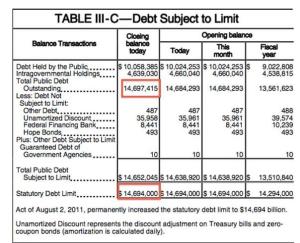
via Deja Vu All Over Again: Total US Debt Passes Debt Ceiling… In Under One Month Since Extension | ZeroHedge. (Watch out for the comments, lots of little boys over there.)
Obama’s buses: they fly first class, too!
RedState reports that the President did not ride those million dollar buses from venue to venue for his tour last week. No, he flew the buses to area, got off Air Force One, and then rode the stage to his next show. This has got to be a joke, right?
Obama will throw America under the bus. If their plane isn’t late.
And it will be from 40,000 feet.
US law enforcement to expand training in Mexico
Police training has been a significant part of the Merida Initiative, which outlined the U.S. partnership with Mexico and Central America in the drug war and has committed $1.4 billion since 2008. However, the focus now shifts to historically out-gunned and ill-prepared local forces ducking bullets and facing ominous threats on a daily basis.
Mexico received $327 million for police training in fiscal 2009 from the U.S. State Department through Merida, placing it behind only Afghanistan and Iraq in total funds received for police training from the departments of State or Defense, according to a report from the Government Accountability Office in April.
via The Associated Press: US law enforcement to expand training in Mexico.
How Farm Subsidies Harm
Or: one of the things I learned while reading “Fed Up,” by Governor Rick Perry, leading me to find this article by the Heritage Foundation:
A recent Washington Post investigation discovered 75 acres of Texas farmland that had been converted into a housing development. Today, the homeowners on these properties (which are worth well over $300,000 each) are eligible for fixed payments for the lawn in their backyards because of its “historical rice production.” Residents never asked for these subsidies and have even stated that as non-farmers they do not want the government mailing them checks.[30] Over the past 25 years, rice plantings in Texas have plummeted from 600,000 acres to 200,000, in part because people can now collect generous rice subsidies without planting rice. If Washington insists on subsidizing farming, subsidizing actual farmland rather than residential neighborhoods that were once farmland would make more sense.
via How Farm Subsidies Harm Taxpayers, Consumers, and Farmers, Too.
Warren Buffett: Private better than government (for his money, not yours)
Warren Buffett’s plea for higher taxes means he wants the government to take more money from other people – but not him. In real life, Buffett says and does underscores his previously stated opinion that private interests “will do a better job with lower administrative costs and better selection of beneficiaries than the government.”
The Wall Street Journal reviews Mr. Buffett’s disingenuous claim that his secretary pays a higher tax rate than he does, ignoring the fact that his regular income is taxed at the highest rate while the bulk of his income is taxed as capital gains or dividends.
The real hypocrisy is that Mr. Buffett takes full advantage of tax shelters, such as his foundations and charities.Most of the middle class, even the “wealthy” that President Obama and Mr. Buffett want to tax at a higher rate – those individuals earning more than $200,000 and couples earning more than $250,000 a year, can’t afford to put millions in tax shelter charities and foundations.
And maybe, just maybe, we, too believe that we can “do a better job with lower administrative costs and better selection of beneficiaries than the government” with our own money.
Click here to get your “Choose Life” license plate

Rick Perry RickPAC
Yes, I'm still for Governor Perry!
RickPAC
SiteMeter
 WingRight